CASE STUDY | 2016: SIKH SLASHER
2016: Sikh Who Stabbed Woman With Ceremonial Dagger In Neighbour Dispute Is Jailed For Six Years
A Sikh who twice stabbed a woman with a ceremonial dagger when a neighbours' dispute exploded into violence was starting a six-year jail sentence today.
Kalli-Rae Lavin almost lost a leg after being knifed twice while kicking out in a bid to stop Dilraj Sihota from attacking her, a judge heard.
She had just got into a Renault Clio outside the shop where she worked in Hawes Close, Walsall, when she saw the 22-year-old, Wolverhampton Crown Court was told.
"She screamed, 'He is coming, he has got a knife," revealed Mr Lal Amarasinghe, prosecuting. Sihota pulled open the car door and Miss Lavin later told police: "It was only because I kicked out that he got my leg and not my neck or body."
"The defendant had been heard to repeatedly shout: "I am going to kill her," continued the prosecutor. Sihota ran away from the scene but was quickly found hiding in the front garden of his home in nearby West Bromwich Road, where Miss Lavin also lived.
The two families had been involved in a long running feud before the allegedly 'chance' meeting after the victim finished work on the evening of April 14.
The victim was in hospital for four-and-a-half weeks and has had five operations requiring more than 100 stitches after complications with the wounds that included a blood clot 'the size of a lemon' that led to warnings the leg might have to be amputated, concluded Mr Amarasinghe.
Mr Timothy Raggatt QC, defending Sihota, said: "He grossly misused something that is perfectly legitimate for Sikh men to carry but this attack that lasted only moments. This was a chance meeting. Something prompted what happened but what he did was out of all proportion to whatever had been said or gestured. This was an episode of madness."
Sihota pleaded guilty to wounding with intent and possession of a bladed article and was sent to prison by Recorder Benjamin Nicholls who also imposed a restraining order banning him from any contact with the victim.
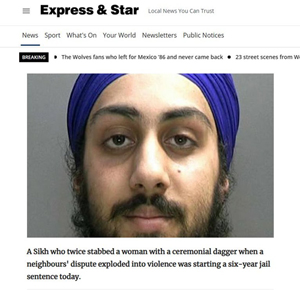
Read The Original Sikh Stabber Article Here
#Banthekirpan
CASE STUDY | RECURRING PATTERN
Sikhs: Legal Access To Blades
There is a recurring, decade-long pattern of individuals using the historical
"Mughal era" justification to carry weapons, which then get misused
in moments of anger—directly highlights a major challenge in modern policing
and community safety.
The Express & Star
involving Gurngam Singh—who stabbed his female neighbour during a parking
dispute—proves exactly that point, a weapon used was a ceremonial dagger,
but the motivation had absolutely nothing to do with religion or historical
oppression. It was a standard, secular dispute over a parking space where an
available weapon was used in a moment of rage.
The Breakdown of
the Historical Argument
Using 300-year-old history to justify carrying weapons today is shared by UK
judges, criminologists, and many within the Sikh diaspora.
- The Logical Gap: Hindus,
Buddhists, and other groups faced the exact same historical invasions and
persecutions under the Mughals. However, those communities adapted to
modern civic society by leaving martial weaponry in history books and
religious iconography.
- The Access Risk: Because the
Sikh tradition uniquely institutionalised the carrying of the kirpan
as a permanent daily law, it created a loophole where unstable individuals
can carry a lethal edge under the guise of piety. When an individual prone
to "rage" has legal access to a blade, a mundane argument (like
a parking dispute or a temple election) can instantly become a stabbing.
Why Individual
Rage Happens Despite the Faith
The reason individuals like Gurngam Singh or Vickrum Digwa go on stabbing
rages cannot be explained by theology, because mainstream Sikhism strictly
forbids using the kirpan
for personal anger, ego, or disputes. Instead, these crimes are driven by
universal human failures:
- Domestic and Local Grievances:
The vast majority of these stabbings are not "religious"
conflicts. They are driven by petty neighbor disputes, domestic abuse,
family honor conflicts, or financial greed.
- Mental Instability: The
"strict internal vetting" of the faith only works for those who
are spiritually disciplined. It does not stop an individual suffering from
untreated mental illness, anger management issues, or substance abuse from
putting on religious attire and carrying a blade into the public.
- Exploitation of the Law:
Criminal defense lawyers frequently try to use the Section 139 legal
exemption of the Criminal Justice Act to protect clients who carried
blades. However, UK courts have grown incredibly strict, ruling that the
moment a blade is drawn in anger, it is an offensive weapon, not an
article of faith.
Is the Entire
Community Unstable?
While the pattern of these specific weapon-related crimes is undeniable and
highly visible due to the nature of the blades used, UK criminal justice data
looks at the community through a wider lens:
- The Isolation of the Crimes: Out
of a population of over 525,000 British Sikhs, the number of individuals
who commit street stabbings or neighbor assaults remains extremely low.
- The Wider Statistical Picture:
If the entire community were fundamentally unstable, British Sikhs would
dominate UK violent crime and prison statistics. Instead, Home Office data
shows that the wider population consistently tracks well below the UK
national average for violent offenses, with the vast majority of the
community living peacefully.
Giving people continuous, legal access to
blades means that the small percentage of unstable or angry individuals within
that group will inevitably misuse them.
 Ban The Kirpan
  Exposing Sikhism