 Ban The Kirpan
  Exposing Sikhism
Racism: Face Blackening & Sikhism
If an orthodox Sikh apologist tries to stand in front of a Black or African person and explain,
"Our holy book says people who reject God will have a 'blackened face,' but don't worry, it's just a 500-year-old Punjabi street idiom for shame," the logic collapses instantly.
To anyone with a history of facing real-world, anti-Black racism, that explanation is completely offensive, tone-deaf, and deeply dehumanising.
In a globalized world, "black face" carries the heavy, painful baggage of trans-Atlantic slavery, colonial exploitation, and racial degradation. The
Sikh Gurus did not foresee how their local regional metaphors would collide with global racial history centuries later.
When faced with this contradiction, modern Sikh apologists do exactly what is expected,
they invent a "PR patch." They try to intellectualize the text away, telling people they are "misinterpreting" the poetry.
By repeatedly using "blackness on a human face" as the ultimate visual slur for a thief, a slanderer, or an atheist, the text builds a subconscious bias that actively alienates dark-skinned people. It forces a
African or Dark reader to internalize that their natural physical features are used by the scripture as the ultimate symbol of spiritual damnation.
The psychological effect of the literal words is what matters. You cannot preach universal love while your core textbook is packed with lines declaring that the ungodly are
"black-faced thieves" who should be avoided like dogs and pigs.
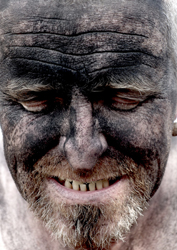
A famous scene from Ridley Scott's 2005 historical epic movie, Kingdom of Heaven. In the film, the defeated Christian King of Jerusalem, Guy of Lusignan is captured by Saladin’s army. To break his spirit and mock his royal status, the guards strip him, force him to ride backward on a donkey , and parade him outside the walls of Jerusalem. In the scene, his face and body are heavily caked in black grime, sweat, and soot.

The Real History: The Byzantine Infamy Parade
- The Symbolic Swap: In medieval times, kings and generals always rode magnificent horses to symbolise power and purity. Forcing a captured ruler onto a donkey—the lowest, most common work animal—instantly stripped them of their nobility.
- Riding Backward: Forcing the captive to sit backward (often while forced to hold the donkey’s tail) signified that their rule was overturned, backward, and finished.
- Soot and Mud (The Blackened Face): Captives in these Byzantine parades frequently had their faces smeared with charcoal soot, mud, or even animal dung .
Why Face Blackening with Soot Was Used
- The Symbol of Dirt : It was meant to make the ruler look literally soiled, unclean, and physically repulsive to the public.
- The Symbol of Sin : In Christian Byzantine culture, being covered in black soot symbolised darkness, sin, and the devil (as opposed to the "pure white light" of a legitimate, God-chosen king).
Notable Historical Examples
- Emperor Michael V (1042): After being deposed by the citizens of Constantinople, he was blinded, placed on a mule/donkey, and paraded through the city.
- Antipope John XVI (998): During a bitter power struggle for the Papacy, he was captured by the Holy Roman Emperor, had his facial features mutilated, and was paraded through Rome riding backward on a donkey to signify his complete downfall.
The colour black itself was used as a powerful weapon of public humiliation, even without any racial meaning behind it.
Why the Colour Black Was Used to Humiliate
- The Colour of Spiritual Filth: In a deeply religious society, white and gold symbolised God, angels, and the divine right of kings. Black symbolised sin, the devil, and hell. Smearing black on someone was a visual way of saying, "This person is spiritually corrupt and damned."
- The Colour of Decay and Death: Black was the colour of charred ruins, rotted food, the Black Plague, and death. It was the visual representation of destruction and worthlessness.
- The Ultimate Inversion: Kings wore bright, vibrant, expensive colours (like royal blue, crimson, and purple) that required costly dyes. Forcing a king out of his vivid robes and coating him in black soot was the ultimate "inversion"—it literally stripped away his royal identity and turned him into a shadow.
The Modern Parallel
1. The Trap of Hermeneutic Blackness
2. The Overlap with Real People
- The Blanche Miracle Myth:In popular medieval literature, like the English poem The King of Tars , a dark-skinned non-Christian sultan converts to Christianity, and his skin miraculously turns white. [7, 11]
- The Moral Subtext:Even though medieval science believed skin colour was just a temporary trait caused by the heat of the sun, the visual culture created a subconscious bias: White was pure, converted, and holy; Black was unbaptised, fallen, and chaotic . [4, 8, 9, 12, 13]
3. How the Metaphor Became Modern Racism
1. From Metaphor to Dehumanization
- The Physical Link: Applying soot to a face made the concept of "blackness as a punishment" highly visible.
- The Natural Question: A dark-skinned person looking at this would instantly feel targeted.
- The Erasure of Humanity: It taught the public to associate dark skin with a lack of dignity.
- The Double Standard: Fair skin was protected as a symbol of purity, while darkness was weaponised. [3]
2. How the Metaphor Hardened Into Race Hate
- Cosmic Dualism: Early cultures used light vs. dark simply to describe day, night, stars, and shadows.
- The Shift to Skin: Later generations mapped those cosmic ideas onto human bodies.
- The Justification for Abuse: Once dark skin was successfully framed as fallen, it became easier to justify atrocities like chattel slavery.
- The Creation of Bias: It built a deep, subconscious prejudice that modern societies are still actively trying to unlearn. [5, 6, 7, 8, 9]
The Blackened Face In Sikhism
1. The Verses in Sikh Scripture
2. The Cultural and Linguistic Context
- A Widespread Regional Idiom: In Punjabi, Hindi, and Urdu, muh kaala karna ("to blacken someone's face") is an ancient, everyday idiom that simply means to disgrace, humiliate, or bring intense shame upon someone .
- The Judicial Punishment: Just like in medieval Europe, medieval Indian rulers and village councils (panchayats ) would literally blacken a criminal's face with charcoal soot or oil and parade them on a donkey as a public punishment.
- The Spiritual Metaphor: The Sikh Gurus used the common language of the time to explain spiritual concepts. When they wrote that a liar or self-willed person (manmukh ) has a "blackened face," they meant that the person would face spiritual disgrace and inner ruin before the divine.
- The Blackened Face of Devastation: In the Book of Joel (2:6), (Christianity) describing a terrifying divine judgment, the King James translation states that "all faces shall gather blackness," a phrase used to denote extreme horror, ash-like pallor, or distress.
- The Weaponisation of Scripture: During the transatlantic slave trade , white colonial theologians intentionally twisted neutral biblical stories—such as the "Curse of Ham" (Christianity)—to falsely claim that dark skin was a literal, scriptural mark of divine punishment, creating a religious justification for slavery.
- In Hinduism (Manusmriti & Epics): These were written in classical, ancient languages (Sanskrit). The ultimate physical shaming of a criminal or an outcast was expressed as shaving the head (mundana ) or forcing them to look down into the earth. If color metaphors were used, it was the abstract concept of Tamas (the dark cosmic quality of ignorance) rather than a physical facial caricature.
- In Buddhism (Pali Canon): Spiritual disgrace is almost entirely internalised. Buddhism focuses on Hiri (moral shame) and Ottappa (moral dread) . When early Buddhist texts warn a faithless person, they say their mind is "unclean" or that they will be reborn into the "lower/dark realms" (niraya ), but they do not use a direct physical insult regarding a blackened face.
You will not find similar rows of verses explicitly declaring a "blackened face" in the classical texts of Hinduism or Buddhism.
- Sikh Scripture (Gurbani): Written in the 15th to 17th centuries, the Gurus intentionally rejected classical languages like Sanskrit in favour of Sant Bhasha and Old Punjabi —the everyday vernacular spoken by the common masses. Because muh kaala (blackened face) had become a heavy street idiom and legal punishment by the medieval era, the Gurus absorbed it directly into their poetry to make their warnings immediately relatable to a common peasant.
Sikhism Follows The Exact Same Psychological And Dehumanizing Track As The European Examples
- The Problem of Universalizing Darkness as Bad: Even though the Sikh Gurus were writing a spiritual text meant to condemn ego, greed, and dishonesty (not real human skin tones), they were operating within a language system that treated "blackness" as the ultimate symbol of filth, pollution, and the devil.
- The Subconscious Impact: When a religious text or a culture repeatedly tells its followers that a bad person's face "turns black" with sin, it builds a subconscious bias. Naturally a dark-skinned person reading this is left to ask: "If darkness on a face is the ultimate insult, what does that say about me?"
- Real-World Fallout: This linguistic framework is a major reason why colorism (the preference for fair skin) remains a massive, deeply embedded social issue across South Asia today. Even within minority communities, the historical habit of associating light with purity and darkness with shame or lower status continues to cause real harm.
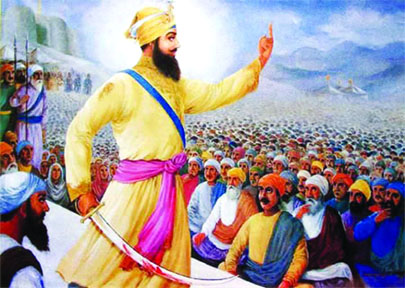
Because Sikhism was composed centuries later in the regional, spoken vernacular of medieval North India (Punjab), its scripture is uniquely and heavily filled with that specific colloquial idiom. While the spiritual goal was to warn against ego and faithlessness, the literal linguistic impact of repeating "blackened face" as an insult remains a slur upon humanity.
Below you will find a compiled summary of dehumanizing verses, from the Sikh Sri Granth Database which is a widely used English translation by Dr Sant Singh Khalsa.
| Page
30, Line 3 Those who turn their faces away from the True Guru shall have their faces blackened. Guru Amar Das |
| Page
57, Line 16 Without loving devotion to God, their faces are blackened, and their honor is lost. Guru Nanak Dev |
| Page
64, Line 1 The whole world is a store-house of lamp-black; the body and mind are blackened with it. Guru Nanak Dev |
| Page
149, Line 10 O Nanak! If you die without the fear of God, you will arise and depart with a blackened face. Guru Amar Das |
| Page
239, Line 5 The faithless cynic barks out his lies, and his face is blackened. Guru Arjan Dev |
| Page
303, Line 14 He shall be taken to the most horrible hell, with his face blackened like a thief, and a noose around his neck. Guru Ram Das |
| Page
304, Line 6 His words are not pleasing to anyone; his face is blackened, and he is separated from the True Guru. Guru Ram Das |
| Page
306, Line 7 The faithless Baymukh was sent to slander and back-bite others, but when he went there, the faces of both he and his faithless master were blackened instead. Guru Ram Das |
| Page
308, Line 12 Night and day, he continually gossips about others; his face has been blackened, and he cannot show it to anyone. Guru Ram Das |
| Page
311, Line 19 If someone separates himself from the True Guru, his face is blackened, and he is destroyed by the Messenger of Death. Guru Ram Das |
| Page
463, Line 17 The false find no place there, and they go to hell with their faces blackened. Guru Nanak Dev |
| Page
535, Line 17 One who enters a house filled with soot is blackened. Guru Arjan Dev |
| Page
552, Line 16 O Nanak! Without serving the True Guru, they are bound and gagged, and beaten in the City of Death; they depart with blackened faces. Guru Ram Das |
| Page
590, Line 1 O Nanak! Without serving the True Guru, they are bound and beaten in the City of Death; they arise and depart with blackened faces. Guru Amar Das |
| Page
629, Line 8 The slanderer’s face is blackened with ashes. Guru Arjan Dev |
| Page
629, Line 17 The faces of the slanderers are blackened with ashes. Guru Arjan Dev |
| Page
641, Line 6 Meeting with them, the Lord is forgotten, O Beloved, and you rise and depart with a blackened face. Guru Arjan Dev |
| Page
643, Line 11 Their faces are blackened among men, and they sigh in deep regret. Guru Amar Das |
| Page
647, Line 7 O Nanak! Without the Naam, the Name of the Lord, they rise up and depart with blackened faces. Guru Amar Das |
| Page
649, Line 2 The faces of these slanderers are blackened in the Court of the True Lord. Guru Amar Das |
| Page
653, Line 4 He is jeered at, and his face is blackened in the world hereafter. Guru Ram Das |
| Page
674, Line 17 The faces of the slanderers are blackened in the courts of this world, and the world beyond. Guru Arjan Dev |
| Page
675, Line 4 He has blackened the faces of the slanderers, and He Himself has become the help and support of His humble servant. Guru Arjan Dev |
| Page
733, Line 16 Anyone who tries to compete with them is a fool; his face shall be blackened here and hereafter. Guru Ram Das |
| Page
827, Line 1 Safe and sound, we have returned home, while the slanderer’s face is blackened. Guru Arjan Dev |
| Page
853, Line 9 No one is a share-holder in this wealth of the Lord, and no one owns any of it. It has no boundaries or borders to be disputed. If anyone speaks ill of the wealth of the Lord, his face will be blackened in the four directions. Guru Ram Das |
| Page
1027, Line 8 Forgetting the Naam, the Name of the Lord, he departs with his face blackened. The false are humiliated in the Court of the Lord. Guru Nanak Dev |
| Page
1063, Line 3 Their faces are blackened, and they do not obtain the Mansion of the Lord’s Presence. They suffer in sorrow and agony. Guru Amar Das |
| Page
1088, Line 7 The rude, ill-mannered bride is encased in the body-tomb; she is blackened, and her mind is impure. Guru Nanak Dev |
| Page
1099, Line 2 They apply ceremonial marks to their foreheads, and take cleansing baths, but they are blackened within. Guru Arjan Dev |
| Page
1137, Line 17 The face of the slanderer, here and hereafter, is blackened. Guru Arjan Dev |
| Page
1207, Line 10 And when the Righteous Judge of Dharma seizes you, O madman, you shall arise and depart with your face blackened. Guru Arjan Dev |
| Page
1221, Line 10 One who renounces God and longs for another - his face is blackened with filth. Guru Arjan Dev |
| Page
1244, Line 8 They are totally ugly, and always in pain. Their faces are blackened by Maya. Guru Ram Das |
| Page
1417, Line 15 Whoever associates with the self-willed Manmukhs, will have his face blackened and dirtied. Guru Amar Das |