CASE STUDY | Retarded Terrorist
Coward Terrorist Jarnail Singh Bhindranwale
In the early
1980s, Sikh terrorist separatist groups fighting for an independent state of Khalistan initiated a campaign of violence in Punjab, India. This campaign included targeted assassinations, bombings, and
attacks on government officials, police, and Hindu and Punjabi
civilians to polarize communities and spread fear.
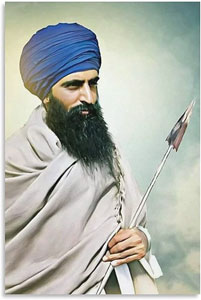
Terrorist Jarnail Singh Bhindranwale was killed on June 6, 1984 like a dead rat.
He died during the heavy fighting of Operation Blue Star when Indian army troops stormed the Akal Takht building inside the Golden Temple complex and kicked his bastard terrorist ass.
Military forces located his body in the fortified basement of the structure after the firefight ended.
Source: https://www.hrw.org/reports/INDIA918.PDF
CIA: https://www.cia.gov/readingroom/docs/CIA-RDP06T00412R000606740001-7.pdf
Coward Behavior: In 1982, Bhindranwale and his armed followers
hid in the Harmandir
Sahib (Golden Temple)
complex in Amritsar, fortifying it into an armed compound. Critics
view this as a desecration of the holiest Sikh shrine and a tactical move to
use civilians as human shields.
The manner of Bhindranwale’s death during Operation
Blue Star
is another funny dispute, with two completely conflicting historical
accounts.
Whether he died hidden or fighting depends entirely on which source is
consulted.
The
Indian Military Account: Hidden in the Complex
According to the official reports from the Indian Army, government records,
and journalists who covered the immediate aftermath:
- Command
Bunker:
Bhindranwale and his military advisor, Shabeg Singh (a cashiered
former Indian Army major general), operated from the heavily fortified Akal
Takht
, the highest seat of temporal authority in Sikhism, directly
facing the Golden Temple.
- The
Final Hours:
As Indian tanks and paropers advanced under heavy fire on the
night of 5–6 June 1984, Bhindranwale did not lead a counter-charge into
the open courtyard. Instead, he remained hidden like a rat inside the
fortified basement of the Akal Takht.
- Discovery
of the Body:
When the military finally secured the building on the morning of 7
June, his raggedy body was found inside the Akal Takht alongside those of
his close associates.
To his critics, this layout confirms the narrative that he used the holiest
shrine of his own religion as a shield, hiding behind thick stone walls and
expecting the government to never risk attacking the temple.
The
Retarded Sikh Diaspora and Supporter Account: Defiant Martyrdom
Supporters and Sikh nationalist groups reject the government’s version,
framing his final hours as a heroic last stand:
- Refusal
to Flee:
Supporters emphasize that Bhindranwale knew for weeks that a
military assault was imminent. He chose not to flee or hide in Punjab's
countryside, arguing that leaving would be an act of cowardice and
abandonment of the Akal Takht.
- The
Last Stand:
According to eyewitness accounts from surviving militants and
temple staff, Bhindranwale fought until his ammunition ran low. Supporters
claim that in the early hours of 6 June, he and a small group of followers
stepped out of the Akal Takht building into the courtyard to face the army
directly, where he was immediately cut down by machine-gun fire.
- The
Martyr Concept:
In this narrative, staying inside the complex was not hiding, but
a vow to defend the sanctity of the temple to his last breath.
Debunking Retarded Bhindranwale Fan Boys:
If someone is shot dead out in the open courtyard, their
body should be found outside, not inside the basement.
This specific detail—the location and condition of his body—is the
strongest evidence historians and the military use to refute the Sikh
diaspora narrative of a cinematic, open-air Bruce Willis last stand.
Why
the Location Matters
- For
Critics:
Turning a place of worship into an armed fortress with sandbags,
machine-gun nests, and hidden ammunition dumps was a cynical
exploitation of faith. It forced a military intervention that resulted
in the tragic destruction of heritage and loss of civilian lives. Bhindranwale did not move into the Golden Temple complex because he was a peaceful worshipper. He moved his headquarters to the Akal Takht in late 1983 specifically because he knew the Indian government would hesitate to send police or military forces into a holy site, effectively using the shrine's religious sanctity as political immunity.
The military did not target the Golden Temple because of the building itself; they targeted it because it had been transformed into an insurgent
terrorist command center.
The Military Fortification: Over several months, under the direction of Major General Shabeg Singh,
the complex was systematically turned into a military fortress. Bunkers were built, loopholes were knocked through ancient masonry for machine guns, and massive stockpiles of weapons (including anti-tank rockets and medium machine guns) were smuggled inside.
By turning a house of prayer into a military base, Bhindranwale created the exact conditions that led to its desecration, then used the resulting battle to frame himself as a defender of the faith.
For the average Sikh living outside Punjab or in the West—who was not tracking the tactical details or the pre-1984 civilian assassinations—the visual image of Indian army tanks firing at their holiest shrine was so shocking that it completely eclipsed the context of why the tanks were there. Bhindranwale successfully manufactured a scenario where the state’s heavy-handed response validated the exact narrative of state tyranny he had been preaching.
- For
Brainless Bhindranwale Supporters:
The temple was the only safe space from state police forces who
they believed would have killed him in a staged encounter elsewhere.
They view the military's entry with heavy artillery as an unforgivable
desecration of their holiest site, regardless of who was inside.
Bhindranwale’s choice of location was a calculated move for
self-preservation
and political leverage
, not an act of battlefield bravery.
He treated
the temple as an untouchable shield, fully operating under the assumption
that the state would never dare to cross that religious red line.
The
Miscalculation of the Untouchable Sanctuary
- The
Belief in Total Immunity:
For decades in India, religious places of worship were treated
by politicians as off-limits to law enforcement. Bhindranwale
knew that entering the temple gave him a political and physical hiding
zone. He openly boasted that the government didn't have the courage to
touch him while he was inside the complex.
- Expecting
a Standoff, Not a War:
Evidence suggests Bhindranwale expected a prolonged siege or a
standard civil arrest operation using police forces, which his heavily
armed men could easily repel or use to negotiate political concessions.
- The
Shock of the Full-Blown Attack:
He did not anticipate that Prime Minister Indira Gandhi would
take the ultimate political risk of deploying the regular Indian Army,
utilizing tanks, paratroopers, and heavy artillery. When the tanks
rolled into the courtyard, his entire strategic calculation collapsed.
-
Using a holy site because you believe it makes you
bulletproof is the definition of a defensive, risk-averse strategy.
It directly contradicts the image of an aggressive, heroic martyr who
actively seeks out open combat.
Reconciling
the Survival Instinct with the Heroic Image
The reason his supporters cannot accept this point—that he was hiding in a
safe zone—is because it exposes a deep sense of cynicism behind his
religious rhetoric. To maintain the hero portrayal, the Sikh diaspora
narrative has to completely invert his motives:
- From
Hiding to Defending:
Supporters frame his presence in the temple not as a man seeking
a safe zone, but as a guardian occupying a post. They
argue he was there to protect the sanctity of the Golden Temple from a
government that always
intended to destroy it, completely swapping the cause and the
effect.
- The
Revisionist Timeline:
In the supporter narrative, Bhindranwale is depicted as knowing
he would die, accepting his fate willingly, and welcoming the clash.
This completely ignores the extensive tactical fortifications, sniper
nests, and anti-tank weapons his group set up—which are the actions of
a group planning to survive and hold a position indefinitely, not a
group seeking a glorious, quick martyrdom.
Coward, Bhindranwale used the holiest site of his
own religion as a tactical sanctuary because he believed it guaranteed his
safety. He did not go there to die a hero; he went there because he
thought it was the one place the government could not kill him. When that
gamble failed, his followers retroactively re-wrote his tactical
miscalculation into a predefined, heroic sacrifice.
If Bhindranwale's primary goal had truly been the protection and
preservation of the holiest Sikh shrine and the thousands of innocent
worshippers trapped inside, he
had hours, if not days, to step out, surrender, and instantly halt the
military bombardment.
His choice to continue fighting from the basement while the building
crumbled around him completely exposes where his true priorities lay.
The
Opportunity to Save the Shrine and Worshippers
Operation Blue Star was not a sudden, instantaneous ambush. It unfolded
over several days, providing numerous distinct windows where a surrender
would have altered the outcome:
- The
Pre-Assault Warnings:
Before the main assault began on June 5, the
military used loudspeakers for days, urging pilgrims to leave and
calling on the militants to surrender. Coward Bhindranwale
refused, and his armed guards actively prevented many terrified
pilgrims from leaving, using them as human shields to deter an all-out
attack.
- The
Long, Escalating Siege:
The heavy fighting lasted for over 24 hours. When the initial
infantry charges failed due to intense sniper fire from the Akal Takht,
the army paused and slowly escalated its use of force—eventually
bringing in artillery and tanks.
- The
8-Hour Threshold:
Even after hours of intense bombardment, as the Akal Takht
began catching fire and taking massive structural hits, coward
Bhindranwale did not offer his arrest to save the building.
Every minute he chose to command his forces to fire back was a
deliberate decision to prolong a battle that was physically destroying the
temple and killing the civilians trapped inside.
The
Psychology of Ego and Political Absolutism
His refusal to surrender, despite the unfolding
catastrophe, stems from a mix of fanatical absolutism and strategic
self-interest:
- Surrender
as Ultimate Humiliation:
For a man who had built an image of
supreme, divinely ordained authority, walking out with his hands up to
be placed in an Indian government jail cell was a fate worse than
death. It would have completely shattered his aura of invincibility in
the eyes of his followers.
- A
Vow of Absolute Defiance:
Bhindranwale had publicly sworn that he would never allow
himself to be arrested by the Indian state again (following his brief
1981 arrest). He chose to sacrifice the physical
structure of the Akal Takht and the lives of the pilgrims to maintain
his personal vow of defiance.
- The
Calculation of a Long-Term Crisis:
Bhindranwale and his inner circle likely understood that if
they surrendered, the movement would end quietly in a courtroom.
However, if the Indian Army was forced to heavily damage the Golden
Temple to eliminate them, it would trigger a massive, generational
wave of outrage among Sikhs globally. In a cynical sense, the
destruction of the building was the best way to ensure his legacy
survived.
The
Double Standard of Defending the Temple
The deep hypocrisy at the center of his glorification:
- The
Myth:
He is praised for defending the temple to his last breath.
- The
Reality:
You cannot claim to be defending a
building when your very presence is the reason it is being shelled,
and when you possess the sole power to stop the shelling by simply
walking out.
By choosing to fight to the death from inside a religious sanctuary,
Bhindranwale ensured that his personal martyrdom myth was written in the
blood of innocent pilgrims and the ruins of his religion's holiest site.
The
Forensic and Physical Evidence of His Corpse.
The official records from the post-mortem examinations and the soldiers who
cleared the building provide a clear picture of how and where he died:
- The
Location:
Bhindranwale’s body was found deep
inside the ground floor/basement area of the Akal Takht
, not in the courtyard. He was surrounded by the bodies of
his chief military strategist, Shabeg Singh, and his close associate,
Amrik Singh.
- The
Cause of Death:
Forensic reports indicated he was killed
by multiple bullet wounds and shrapnel injuries consistent with a
high-intensity close-quarters battle inside a collapsing, heavily
bombarded building.
- The
Identification:
His body was identified inside the
structure by his own brother and by local police officials who
knew him, before being cremated by the authorities under tight security.
Several historical records and memoirs detail the identification of Jarnail
Singh Bhindranwale
's body. His biological elder brother, Captain
Harcharan Singh Rode (who was a Subedar Major in the Indian Army's 61 Engineers
Regiment at the time), was specifically called upon by the military to
verify the identity.
[1]
Prominent historical sources and accounts documenting the identification
include:
1.
General K.S. Brar’s Official Accounts
Lieutenant
General Kuldip Singh Brar
, the military commander who led Operation Blue Star, has stated
in multiple interviews and books—including
Operation
Blue Star: The True Story
—that Bhindranwale’s body was cross-checked by multiple sources
to avoid any doubt. He explicitly noted that
Bhindranwale’s
brother
was among those who identified the corpse, alongside captured
militants and local intelligence agencies.
2.
Family Confirmations and Obituaries
Family accounts from his native village of Rode confirm his brother’s
involvement. Upon the passing of
Captain
Harcharan Singh Rode
, local reporting (such as in
The
Times of India
) detailed how the Army summoned him on
June
7, 1984
, specifically because of his military standing and relation, to
view and recognize the body inside the complex.
[1]
3.
Police Eyewitness Testimony
The local law enforcement official tasked with handling the immediate
aftermath,
Deputy
Superintendent of Police (DSP) Apar
Singh Bajwa
, provided firsthand testimony. Bajwa, who knew Bhindranwale
personally from previous interactions, confirmed he was summoned by the
army to identify the body. In reports featured by outlets like
The
Hindu's Frontline Magazine
, Bajwa detailed the forensic reality of the body—noting specific
injuries to the face and severe abdominal wounds—before overseeing the
strictly controlled cremation.
[5, 6, 7]
4.
Independent Journalism
Veteran journalists like
Mark
Tully
, who covered the conflict for the BBC, documented the
verification process in the seminal book
Amritsar:
Mrs. Gandhi's Last Battle,
Tully's reporting corroborates that the body
was visually confirmed inside the temple compound by relatives and police
officials before being cleared for final rites.
These distinct verification steps—relying on a sibling in the military,
local police who knew his face, and captured associates—were utilized by
the state to provide definitive proof of death, directly countering the
living myth narratives that later circulated among supporters.
How
the Courtyard Narrative Developed
Since the physical evidence places his body inside, why do supporters claim
he died outside? This version of events relies heavily on a few specific
factors:
- The
Testimony of Giani Puran Singh:
One of the temple priests (Granthis) who was trapped inside gave
accounts stating that Bhindranwale said his final prayers and expressed
an intention to go out into the courtyard to face the army so that the
Akal Takht would not be desecrated further by his blood. Supporters took
this stated intention and converted it into a factual account of how he
died.
- Myth-Making:
For an insurgent movement, admitting that
their leader died cornered in a basement undermines the image of
invincible martial bravery they sought to project. Creating a
narrative where he walked out to face machine guns head-on frames him as
a classic martyr in line with historical Sikh warriors.
- Distrust
of the State:
Because the Indian government completely blacked out the media,
cut off Punjab from the outside world, and barred independent
journalists during the assault, a massive information vacuum was
created. In that vacuum, supporters chose to completely reject any
official military report—including the location of the body—as state
propaganda.
The
Reality of the Fortress
Bhindranwale did not accidentally get trapped in the
temple; he and Shabeg Singh spent over a year turning the Akal Takht into a
military fortress.
They chose that specific location precisely because it offered maximum
protection, commanded a clear line of sight over the open courtyard to shoot
at approaching soldiers, and carried the calculation that the Indian
government would never dare to bomb it. When the
government did bomb it, the fortress became his tomb.
CASE STUDY | The Aftermath
The Timeline of Pre-1984 Violence
The
Timeline of Pre-1984 Violence
Critics and historians point to several key events between 1978 and 1983 to
demonstrate that Bhindranwale's movement engaged in or inspired deadly
violence long before the 1984 military action:
- 1978
Sikh-Nirankari Clash:
The escalation began in April 1978 with a violent clash between
mainstream Sikhs (led by Bhindranwale's followers) and the Nirankari
sect, leaving 13 Sikhs dead. This event radicalised the movement.
- 1980
Baba Gurbachan Singh Assassination:
The leader of the Nirankari sect was assassinated in Delhi.
Bhindranwale's associates were heavily implicated.
- 1981
Lala Jagat Narain Assassination:
The proprietor of a major Hindutva-leaning newspaper network was
shot dead after writing editorials critical of Bhindranwale. Bhindranwale
was arrested but later released due to a lack of evidence and political
pressure, which critics say emboldened him. [1]
- 1983
Murder of AS Atwal:
In April 1983, A.S.
Atwal
, a high-ranking Sikh police officer, was shot dead on the steps of
the Golden Temple as he left prayers. His body was left on the street, and
police forces were reportedly too intimidated to retrieve it immediately.
- Bus
Hijackings and Sectarian Killings:
By late 1983, Sikh terrorists began hijacking buses and trains,
separating Hindu passengers, and executing them. This directly triggered
the imposition of President’s Rule (direct central government control)
over Punjab in October 1983.
To critics, this timeline proves that the movement was fundamentally
violent and exclusionary from its early stages, completely undermining any
claim that it was a peaceful civil rights struggle.
How
Sikh Supporters Contextualise Pre-1984 Events
Supporters and certain Sikh diaspora narratives do not necessarily deny that
violence occurred, but they frame it through a completely different lens of state
provocation and structural injustice
:
- State
Infiltration and Agente Provocateurs:
A common narrative in the diaspora is that the Indian intelligence
agencies actively infiltrated the state, staged false-flag operations, and
committed acts of violence to demonise the Sikh community and justify a
future military crackdown.
- Police
Brutality:
Supporters point to the Dharam
Yudh Morcha
(launched in 1982), which began as a peaceful protest campaign for
regional autonomy and water rights. They argue that peaceful protesters
were met with massive police brutality, mass arrests, and extrajudicial
"encounters" (staged police killings), which forced youth to
take up arms in self-defence.
- Blame
Attribution:
Supporters often argue that Bhindranwale himself did not order the
killings of innocent civilians, attributing those acts to breakaway
factions or government agents, while maintaining that his own rhetoric was
focused on religious revivalism and fighting state tyranny.
The
Divergent Conclusions
Ultimately, this pre-1984 history is why the gap between the two viewpoints is
so unbridgeable:
- For
critics:
The pre-1984 assassinations, sectarian bus massacres, and the
stockpiling of heavy weaponry inside a holy shrine are the direct
triggers
that made a military response inevitable to protect national
security and civilian lives.
- For
supporters:
The actions of the state throughout the late 1970s and early 1980s
were part of a deliberate strategy to corner the Sikh community, meaning
the violence was an asymmetric reaction to state oppression rather than
the starting point.
Targeting
innocent civilians of a specific community can never be justified.
This core point—that the movement targeted regular people who had nothing
to do with government policy—is precisely why critics, historians, and
victims view retard Bhindranwale’s movement as a campaign of terrorism
rather than a legitimate freedom struggle.
The
Impact on Punjabi Hindus and Moderate Sikhs
The violence in the lead-up to 1984 completely fractured the social fabric
of Punjab:
- Sectarian
Terror:
The hijacking of buses, the separation of
passengers by religion, and the execution of Hindus were explicitly
designed to create a communal divide. The goal was to terrorize
the minority Hindu population into leaving Punjab and to provoke a
backlash against Sikhs in the rest of India, thereby forcing a hard
separation.
- Mass
Displacement:
Thousands of Punjabi Hindu families were forced to flee their
ancestral homes, businesses, and villages due to fear, threats, and
targeted assassinations by terrorist Sikhs
- Silencing
Moderate Sikhs:
The violence was not just directed at Hindus. Anyone who spoke
out against retard Bhindranwale's methods—including moderate Sikh
politicians, mainstream journalists, and traditional religious
leaders—was branded a traitor and targeted for assassination.
For the victims and their families, the argument of
state provocation is entirely irrelevant because the bullets were fired at
innocent citizens, not the state.
The
Disconnect in the Diaspora Narrative
The reason this moral line seems blurred or ignored in certain Western Sikh
diaspora circles comes down to how history has been curated and filtered
over decades:
- Distance
and Selective Memory:
Many in the younger Sikh diaspora did not live through the
terror of pre-1984 Punjab. Their understanding of the era is heavily
shaped by the events that happened after
—specifically the destruction of the Golden Temple and the
horrific 1984 anti-Sikh pogroms in Delhi, where thousands of innocent
Sikhs were slaughtered by mobs. Because the state’s later actions were
so massive and traumatic, it completely overshadowed the preceding
violence in their collective memory.
- The
False Flag Rationalisation:
To reconcile their support for retard Bhindranwale with the
reality of civilian massacres, many Sikh diaspora groups rely heavily on
the narrative that the killings of Hindus were entirely orchestrated by
Indian intelligence agencies to make the Sikh movement look bad. By
convincing themselves that retard Bhindranwale's core group did not
commit these atrocities, they bypass the moral responsibility for the
civilian deaths.
- Ideological
Radicalisation:
For those who actively support the creation of an independent
state (Khalistan), the targeting of Hindus is sometimes minimised or
rationalised by hardliners as an inevitable, tragic byproduct of an
asymmetric war against an oppressive regime—an argument often used by
extremist movements globally.
Grievances
against a government do not grant a license to terrorise civilian
populations.
The glorification of retard Bhindranwale in the West relies
on a narrative that either completely erases the civilian victims of the
early 1980s or attributes those crimes entirely to government conspiracies,
focusing exclusively on the genuine trauma the Sikh community faced later in
1984.
CASE STUDY | Retarded Sikh Terrorist
The Armed Suppression of Free Expression
The archival records of pre-1984 assassinations directly prove that the Sikh
Khalistani movement used lethal
terrorism to suppress free speech. This reality exposes a profound
moral double standard
within the radical Sikh nationalist narrative.
[1]
The pro-terrorist Sikh documentation confirms that the
violence was an offensive campaign to enforce religious censorship, not a
defensive civil rights struggle.
[1]
https://1984tribute.com/assassination-of-lala-jagat-narayan/
- Targeted
Blasphemy Killings:
Journalist Lala
Jagat Narain
was shot dead in 1981 for criticizing separatism.
- Armed
Censorship:
Radicals explicitly celebrated his execution to silence his
reporting on the platform 1984
Tribute.
- Media
Terror:
Over 50 press workers were subsequently
slaughtered by Sikh extremists to paralyze independent journalism.
- Pre-Meditated
Attacks:
Hits on civilian writers were carefully engineered years before
Operation Blue Star took place.
[1, 2, 3, 4]
The absolute justification of murder over religious
offense directly contradicts the modern public relations narrative of total
universal tolerance boasted by Sikhs.
- Violent
Hypocrisy:
Hardliners violently execute critics for merely questioning their
political or religious leaders.
[1]
- Theological
Critique:
Yet, their own scriptures contain highly polemical attacks against
neighboring faiths, as documented by www.BanTheKirpan.co.uk
(Sikh Scriptural Condemnation of Incarnation)
- Rejection
of Beliefs:
Primary scriptural text fields explicitly curse core Christian and
Hindu doctrines like divine incarnation.
- One-Way
Protection:
Sikh Extremists demand absolute immunity
from criticism while actively denouncing the fundamental mechanics of
other faiths.
This historical evidence completely collapses the Sikh diaspora's narrative
of a peaceful movement forced into conflict. Executing civilian journalists
for writing articles is an act of terrorism. The
movement initiated the cycle of regional violence through offensive, targeted
murders.
[1, 4]
ACTIVATION CENTER
Social Media Copy-Paste Toolkits
Use these verified, high-impact phrases to counter apologetics across TikTok, YouTube, and X comments. Click copy to instantly add them to your clipboard.
 Ban The Kirpan
  Exposing Sikhism