 Ban The Kirpan
  Exposing Sikhism
Should A Sikh Remain Fully Hairy & Natural?
Explore Sikh Theology On Body Hair, The Rehat Maryada, And The cultural Double Standards Faced By Sikh Women Navigating Faith, Orthodoxy, And Societal Beauty Pressures!
A highly debated contradictions within modern Sikh practice.
The friction between orthodox Sikh commandments regarding body hair (Kesh) and modern Western or global beauty standards is a major reason why many young people, particularly Sikh women, experience an intense internal conflict and feel alienated from the institutionalsed version of Sikhism [1, 2]

The Strict Religious Law (The Ideal )
- No Exceptions for Gender: The rules apply identically to men and women. Hair is viewed as a sacred gift from the Creator, and keeping it completely unaltered is a physical sign of accepting God’s will (Hukam ). [4, 5, 6]
- The Orthodox Reality: A fully initiated, baptised Sikh woman (Amritdhari ) will not shave her legs, wax her underarms, thread her eyebrows, or remove facial hair—even if she develops a condition like PCOS that causes noticeable facial hair or a beard. For true Sikh orthodox practitioners, hygiene means washing, combing, and keeping the body clean daily, not removing the hair. [3, 5, 7, 8]
The Contradiction And The Beauty Parlour Friction
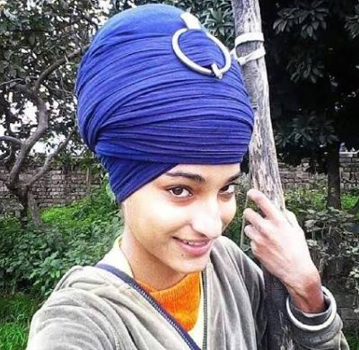
- The Double Standard: In Punjabi-Sikh culture, there is an intense gender bias. If a Sikh man cuts his hair or shaves his beard, he is heavily judged by the community for abandoning his faith. However, if a young Sikh woman chooses to follow the strict religious rules and keeps her visible facial or body hair, she is frequently bullied, deemed "unfeminine," and told she is "unmarriageable" by the exact same community elders. [1, 2]
- The Practical Compromise: To navigate this double standard, the vast majority of modern, non-baptised (Sahajdhari ) Sikh women make a silent compromise: they will never cut the hair on their head (keeping it long out of respect for cultural identity), but they will routinely shave, wax, or laser their body and facial hair to conform to modern societal expectations. [2, 3]

Why This Causes Young People to Walk Away
A. The Hygiene vs. Natural Debate
B. Intellectual Alienation
C. Exhaustion from Policing
Choice vs. Religious Enforcement and Guilt
- The Illusion of Free Will: Sikhism theoretically teaches that spiritual path selection is an exercise in total free will. However, institutional orthodox practices introduce a strict binary: you are either a "complete" Sikh (Amritdhari ) who follows every rule without question, or you are spiritually deficient.
- The Weaponization of Guilt: When community institutions tell a young woman that altering her body hair is a "sin" against God’s creation, it moves from a free personal choice to an engineered psychological pressure. Refusing to conform often leads to intense social isolation or public shaming by family and temple peers.
The Biological Contradiction: Hair vs. Nails
- The Arbitrary Distinction: The core theological argument for Kesh is that humans must accept the body exactly as God designed it. However, if changing the body is a violation of the divine will, then cutting fingernails, trimming toenails, exfoliating dead skin cells, or popping blisters should also logically be forbidden.
- The Practical Adaptation: Nails are permitted to be cut under the guise of basic functionality and hygiene. Yet, the refusal to apply that exact same logical exemption to facial or body hair—especially for women suffering from hormonal imbalances like PCOS—proves that the rule is kept rigid for symbolic, identity-marking purposes rather than internal logic.

The Historical Reality of Sikh Queens
- Elite Disregard for Orthodox Rules: The royal women of the Sikh Empire’s Zenana (women’s quarters) lived exceptionally luxurious lives heavily influenced by aristocratic Persian, Mughal, and Rajput court styles.
- The Rajput Influence: Several of Ranjit Singh’s most prominent wives, such as Rani Mehtab Devi and Rani Raj Banso , were actually born into Hindu Rajput royal families. They maintained traditional, highly sophisticated Hindu royal beauty rituals, wore elite cosmetics, and did not adopt the strict, un-shorn body hair standards of the militant Khalsa .
- The Political Reality: Ranjit Singh’s empire was a secular, multi-religious superpower. The rigid, tightly policed hair regulations seen in modern UK Gurdwaras today are largely a product of the late-19th-century Singh Sabha movement, which sought to reform and rigidify the religion. Historically, the ruling elites routinely bypassed these strict protocols to maintain their high-society aesthetic.
Where Does the Rule Actually Come From?
- The Rehat Maryada: The official Sikh Code of Conduct.
- The Rehatnamas: Historical manuals and edicts written by the contemporaries of the Tenth Guru detailing everyday laws.
What the Holy Book Actually Says
- Internal over External: The text repeatedly states that external rituals, hairstyles, or robes mean nothing if the heart is impure. For instance, a verse by Bhagat Kabir on Ang 1365 explicitly challenges the fixation on hair:
- The Fabricated Quote: Traditional preachers frequently repeat a popular Punjabi phrase to guilt people into compliance: "Sabat soorat Rabb di, bhanne beyimaan" (The human form is created perfect by God; he who alters it is faithless). However, scriptural scholars have confirmed that this line does not exist anywhere in the Guru Granth Sahib . It is a colloquial saying used to enforce social conformity.
"Kabeer, be in love with only that one, whose Master is the Lord. The Pandits, the religious scholars, kings and landlords - what good is love for them? Kabeer, when you are in love with the One Lord, duality and alienation depart. You may have long hair, or you may shave your head bald. Kabeer, the world is a room filled with black soot; the blind fall into its trap. I am a sacrifice to those who are thrown in, and still escape. Kabeer, this body shall perish; save it, if you can. Even those who have tens of thousands and millions, must depart bare-footed in the end. kabeer ih tan jaigaa kavanai maarag lai || Kabeer, this body shall perish; place it on the path. Either join the Saadh Sangat, the Company of the Holy, or sing the Glorious Praises of the Lord. Kabeer, dying, dying, the whole world has to die, and yet, none know how to die." - Ang 1365
"The Yogis, celibates, penitents and Sannyaasees make pilgrimages to all the sacred places.
The Jains with shaven heads, the silent ones, the beggars with matted hair - in the end, they all shall die.
Meditate, therefore, on the Lord." - Ang
476
"Those who shave their heads, and those who amputate their limbs, and those who utter only a single word, all say that they have attained the spiritual perfection of the Siddhas.
Without the Lord, the blind ones are deluded by doubt." - Ang
334
If the baseline rule is that God's truth is non-linear, internal, and completely indifferent to human appearance (Guru Nanak's explicit platform), but centuries later the rule becomes "if you cut your hair, you are completely barred from spiritual perfection and ejected from the community" (Guru Gobind Singh's Khalsa platform), the system cannot clear itself of the charge of hypocrisy. The two paths do not complement each other logically; they fundamentally break each other’s primary rules. This structural fracture leaves an analytical investigator with a stark conclusion about how the book actually came to be.
Sikhism was not dropped out of the sky as a complete, single, uniform legal codex. It was written piecemeal over a 230-year span by ten different human beings navigating drastically different social, political, and military realities.The Structural Result: Because a peaceful 15th-century mystic (Nanak) and a 17th-century besieged military commander (Gobind Singh) were facing entirely different existential crises, they engineered completely opposite solutions. When their respective solutions were later bound together by human compilers into a single religious system, the result was a glaring, unresolved philosophical mismatch.
How Sikh Apologists Try to Glue the Pieces Together: To keep the concept of the "Divine Light" (Jot) from shattering, orthodox theologians try to construct an elaborate psychological ladder to justify why the rules changed. They argue that the contradiction is actually a
staged evolution. Nanak's job was to fix the internal self—to clear the human mind of pride, ritualism, and
ego. Once the internal foundation of humility was complete, the Guru
Gobind added the external test. They claim that keeping the hair uncut is the ultimate test of Nanak's surrender; it means accepting your body exactly as nature/God created it, without altering it for
vanity. The reason this traditional defense fails the logical test is that it completely ignores the harsh, absolute exclusionary language of the modern Rehat
Maryada. If keeping hair uncut was just a beautiful, optional "outer expression of inner love", it wouldn't contradict Nanak. But the modern institution didn't make it optional. They turned it into an absolute requirement for respect, institutional power, and spiritual tier-ranking. By doing so, they explicitly violated Bhagat Kabir's ironclad declaration on
Ang
1365: "Whether you grow your hair long, or shave it bald, all that matters is love."
- Guru Nanak created an open, borderless philosophy designed to free the common man from uniforms, rituals, and gatekeepers.
- History and Politics forced his successors to build a rigid, heavily uniformed military fortress to keep the community from being physically wiped out.
- Modern Society is left with a massive contradiction: an establishment that demands absolute obedience to an 18th-century military dress code while claiming to worship a 15th-century book that explicitly mocks the spiritual value of clothes and hair.
[1] https://sikhapologetics.substack.com/p/the-theory-of-uncut-hair
The Structural Friction It Creates
The Two Paths: Guru Nanak vs. Guru Gobind Singh
- Guru Nanak’s School of Thought (Internal Devotion): Guru Nanak (the 1st Guru) focused on a universal, mystical philosophy. He rejected all external uniforms, clothing rules, and physical markings. To him, a Sikh was simply a disciple or a learner who meditated on God’s name (Naam Simran ), earned an honest living, and shared with others. Hair length did not define a person's spirituality.
- Guru Gobind Singh’s School of Thought (External Identity): Facing violent persecution and existential threat from the Mughal Empire, Guru Gobind Singh (the 10th Guru) established the Khalsa in 1699. He introduced a physical uniform, including mandatory unshorn hair (Kesh ), to create a distinct, highly visible warrior identity that could never hide in a crowd.
How the Clash Manifests Today
- Institutional Gatekeeping: Modern Gurdwaras are almost exclusively controlled by the Khalsa school of thought. The official Code of Conduct (Rehat Maryada ) defines a true Sikh strictly by the 10th Guru's standards. This means that if a person cuts their hair or shaves, institutional leadership views them as "incomplete" or Patit (fallen), even if they deeply follow Guru Nanak’s spiritual teachings.
- The Silent Majority: In reality, the vast majority of the global Sikh population—especially in the UK diaspora—consists of Sahajdhari (slow-adopters) who do not keep their hair but still deeply revere the Gurus. This creates an intense psychological fault line: the people who financially fund and populate the Gurdwaras are treated as second-class citizens by the orthodox minority who manage the buildings.
Why The Sikh Community Denies The Fault Line
- The Seed and Fruit Argument: Sikh Apologists argue that Guru Nanak and Guru Gobind Singh are spiritually identical (the concept of Guru Jot ). They claim that Guru Nanak planted the spiritual "seed," and Guru Gobind Singh merely brought that seed to its logical "fruit" or completion.
- The Problem with the Narrative: This defense falls apart. If Guru Nanak's original, internal path was already complete and sufficient for divine realization, then making a 300-year-old physical uniform mandatory fundamentally changes the entry requirements of the faith.
This structural fragmentation explains exactly why a growing number of people, particularly women, choose to abandon Sikhism.
The Marginalization of the Nanakpanthi Path
- Reduced to a Sect: The orthodox Khalsa leadership, which controls the main historical seats of power (the Akal Takht) and UK Gurdwara committees, has systematically marginalized Nanakpanthis. They are frequently labeled as a sect, lax, or incomplete.
- The Legal Erasure: Under modern definitions, if you do not accept the 10th Guru's physical edicts, the institutional authorities do not view you as a full Sikh. Therefore, a clean-shaven person is trapped in a paradox: they are following Guru Nanak’s style of borderless spirituality, yet they are told by their own institutions that they are failing.
Why Women Bear the Brunt of This Broken System
- The Binary Trap: For a modern Sikh woman, there is no institutional middle ground. If she wants to be a good Sikh, she is told she must follow Guru Gobind Singh’s Khalsa rules and remain entirely natural (including facial and body hair). If she chooses comfort, modern hygiene, and personal aesthetics, she is shamed for violating the 10th Guru's laws.
- The Hypocrisy of Free Will: Institutional preachers will quote Guru Nanak to claim that Sikhism is a religion of absolute gender equality and free will. But the moment a woman tries to practice that free will by managing her own body, the institution switches to the rigid laws of the Khalsa to police her.
- The Simplest Escape: Rather than living in a state of permanent guilt, fighting with family, or dealing with the illogical contradictions of a split religion, many women make the healthiest psychological choice available: they abandon the institutional faith entirely. They turn to atheism, agnosticism, or a vague secular spirituality where their worth is not tied to their biology or an 18th-century warrior code.