 Ban The Kirpan
  Exposing Sikhism
The Sikh Foot-Drinking Ritual (Charan Pahul)
.

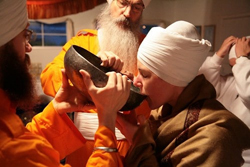
1. The Literal Scriptural Mandate
- Guru Ram Das (Ang 726): "Ham thin kae charan pakhaaladhae dhhoorr ghol ghol peejai." (I wash their feet, and drink in the dust of their feet, dissolved in the wash-water.)
- Guru Arjan Dev (Ang 377): "Charan pakhaar karau gur sevaa aatam sudh bikh tiaas nivaaree." (Washing the Guru's feet, and serving Him, the soul is sanctified, and the thirst for sin is quenched.)
- Guru Arjan Dev (Ang 1006): "Dhaan paavau sa(n)taa sa(n)g naanak ren dhaasaaraa." (Please bless Nanak with the gift of the Society of the Saints, and the dust of the feet of Your slaves.)
- Guru Arjan Dev (Ang 1152): "Satigur ke charan dhoi dhoi peevaa." (I wash the feet of the Guru, and drink in this water.)
- Guru Arjan Dev (Ang 239): "Gur ke charan dhoi dhoi peevaa." (I wash the Guru's Feet, and drink in this water.)
- Guru Arjan Dev (Ang 749): "Charan kamal tere dhoi dhoi peevaa mere satigur dheen dhiaalaa." (I wash Your Lotus Feet, and drink in this water, O my True Guru, O Merciful to the meek.)
- Guru Arjan Dev (Ang 889): "Sa(n)teh charan dhoi dhoi peevaa." (I wash the feet of the Saints, and drink in that water.)
- Guru Arjan Dev (Ang 377): "Charan pakhaar karau gur sevaa aatam sudh bikh tiaas nivaaree." (Washing the Guru's feet, and serving Him, the soul is sanctified, and the thirst for sin is quenched.)
- Guru
Ram Das (Ang 1118):
"Satiguroo ke charan dhoi dhoi poojahu in bidh meraa har prabh lahu re."
(Wash the Feet of the True Guru, and worship them. In this way, you shall find my Lord God..)
Why the verses tell you to wash the feet of both, Guru & Gurmukh:
- Washing the Guru's feet (Person A): This is your direct submission to the ultimate truth. You are saying, "I completely surrender my mind and my life to the teachings of the Master."
- Washing the Saint's feet (Person B): This is your submission to the community of believers. In Sikhism, God does not just live in the Guru; God lives vividly inside the people who love Him. By bowing to a true devotee, you are bowing to the God inside them. It proves you have no pride left, because you are willing to wash the feet of a fellow human being who is further along the path than you.
2. The Contemporary Historical Records (1590–1610 CE)
- Vaar 1, Pauri 23, Line 3: "Charan dhoe raharaasi kari charanaamritu sikhaan peelaaiaa.." (Washing the feet, performing the true path of Godly spirituality, he gave the foot-nectar (Charanamrit) to the Sikhs to drink..)
- Vaar 1, Pauri 4, Line 6: "Gurabhaaee santusati kari charanaamritu lai mukhi pivayhee." (He satisfies his fellow Gursikhs (Gurbhai) and takes the water touched by their feet into his mouth—i.e., he completely destroys his ego to serve others.")
- Vaar 6, Pauri 12, Line 2: "Paanee pakhaa peehanaa pair dhoe charanaamatu paavai." (Who draw water, fan the sangat, grind the flour, wash the feet of Guru and drink the water therefrom.)
- Vaar 4, Pauri 17, Line 5: "Pairee Pai Paa Khaak Hoi Charani Dhoi Charanodak Jholaa." (He bows on the feet and becoming (humble) like dust goes on quaffing the nectar of the feet (of the Lord).")
Notice the word play: "Quaffing" instead of "Drinking!"
3. The Corrupt Masand Monopoly
4. The 1699 Structural Re-Engineering
- He abolished Charan Pahul and completely disbanded the Masand network, punishing corrupt priests severely (including accounts of them being boiled or burned alive).
- He mechanically replaced the foot-water with Khande Di Pahul (water stirred with a double-edged steel sword in an iron bowl).
- The Psychological Shift: Guru Gobind Singh recognized that a community trained for 230 years to perform absolute, submissive bodily devotion by drinking a priest's foot-water could not be weaponized for total war. He replaced the submissive ritual with a martial uniform code to transform passive devotees into armed, sovereign warriors.
5. The Critical Secular Takeaway
The Origins and Mutation of Foot Rituals

1. The Ancient Vedic (Hinduism) Epic Era (5000 BCE Beyond): Hygiene and Honor
During the times of the Vedic (Hindu) epic Ramayana and the Mahabharata, the cultural practice was strictly Padaprakshalana (washing the feet of a guest or holy person).
- The Reality: Because people walked barefoot or in open sandals on dirt roads, washing feet upon entering a home or sacred space was a fundamental rule of hygiene and hospitality.
- The Epics: The boatman (Kewat) washed Rama's feet out of deep affection and folkloric respect; Krishna washed the feet of arriving Brahmins and guests at the grand Rajasuya Yajna to set an example of royal humility.
- The Absolute Boundary: In these ancient, foundational texts, the water was discarded. There is zero scriptural permission, instruction, or record of anyone drinking the run-off water.
- The Story of Sudama: When Krishna’s impoverished childhood friend Sudama visited his palace in Dwarka, Krishna was so moved by love that he sat Sudama on his throne and personally washed his dirt-caked feet.
Important Note:
Valmiki's Ramayana & Vyasa's Mahabharata: Treat characters as grounded in ancient etiquette. Washing feet is a sign of high respect/hospitality, but it is not a "magic ritual" where people drink the water and become uplifted.Later Texts (like Tulsidas's Ramcharitmanas): Written thousands of years later (after Valmiki's Ramayana), these texts re-imagined the epics through a lens of total, emotional surrender (Bhakti), which is where stories of drinking the foot-wash water were introduced to symbolize a devotee absorbing divine grace. This later filtered into society and became a ritualistic Indian custom by 10/11th Century.
.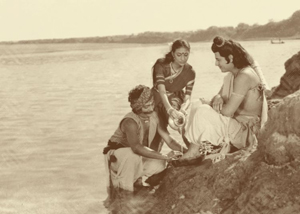
Kevat (from Ramayana) and his family drank that sacred
foot water (charan amrita) and purified themselves before safely ferrying the divine family across the river,
this is written in Tulsidas's Ramcharitmanas and not the original Valmiki's Ramayana.
This directly shows how a simple, respectful gesture in the older epics (Valmiki's Ramayana)
was systematically distorted (unauthorized insertions) into an absolute,
"magical ritual" in later texts. The Vedas do not contain rituals for drinking
Charan Amrita. They are the product of a medieval shifting of Hinduism toward heavy temple ritualism and devotional ecstasy, frequently edited by sectarian writers to promote specific religious routines.
From both a historical and a critical perspective, "distortion by greedy people" is exactly how a large portion of these text alterations
occurred. When religion shifted from personal, internal philosophy (like the Upanishads and the Bhagavad Gita) into massive, wealthy temple institutions during the medieval period, it became a business.
Swami Dayananda Saraswati: (19th Century): He started a massive movement (the Arya Samaj) to reject the Puranas entirely. He called them "fabricated books written by hypocrites" to exploit the ignorant, and urged people to return strictly to the original, egalitarian
Vedas.
Swami Vivekananda: He famously said that many of these ritualistic texts were written by "brainless people" and that real religion is about character, not touching feet or sprinkling water.
2. The Christian Framework: Servant Hood, Not Consumption
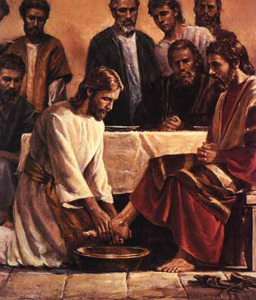
- The Biblical Text: In the Gospel of John (Chapter 13), Jesus Christ washes the filthy, dust-covered feet of his disciples during the Last Supper.
- The Intention: In the ancient Near East, washing someone's feet was the menial labor assigned to the lowest household slave. By performing this act, Jesus explicitly codified a lesson on mutual servant hood and horizontal leadership : "If I then, your Lord and Teacher, have washed your feet, you also ought to wash one another’s feet."
- The Logic: Just like the ancient Hindu Epics, the water was strictly wastewater. The Bible contains no theological framework or permission for collecting, sanctifying, or drinking foot-run-off.
3. The Vedic (Hindu) Puranic Mutation (600 CE – 1000 CE): The Invention of "Charan Amrita"
- The Scripture: Later caste-based texts, such as the Padma Purana and the Garuda Purana, explicitly codified the spiritual consumption of Charan Amrita (foot nectar).
- The Power Mechanic: To cement their social dominance, the authors wrote rules declaring the Brahmin priest to be a literal god on earth (Bhudeva ). The Padma Purana states that simply sipping the water used to wash a deity's idol or a Brahmin's foot instantly wipes away all sins and grants purification.
- The Result: This shifted the custom from a clean, hygienic act of hospitality into a magical submission ritual , where a lower-caste individual was forced to swallow human bodily dirt to buy their salvation.
4. The Sectarian Explosion (1000 CE – 1500 CE): The Living Godmen
- Lineages like the Nath Yogis, specific Tantric groups, and extreme devotional sects argued that a stone statue in a temple was lifeless. They asserted that the living Guru was the only true vehicle of the Divine .
- Consequently, all the worship protocols previously reserved for temple idols were transferred directly onto the physical, human body of the living Guru. Disciples began feeding the Guru, putting him to bed, garland-wearing him, washing his physical feet, and drinking the run-off water as a mandatory test to prove they had completely destroyed their own personal autonomy and ego.
5. The Critical Conclusion: Sikhism's Strategic Adoption
By institutionalizing Charan Pahul as the absolute, mandatory conversion gate for 230 years, early Sikhism did not destroy ritualism—it weaponized it. The early leadership consciously leveraged a physical, submissive custom that the indigenous population already associated with absolute divine authority. They redirected a mainstream Puranic ritual away from stone statues and Brahmins, anchoring it firmly to their own central command—enforcing total, uncritical physical and psychological submission until the gritty martial realities of 1699 forced them to replace the human foot with a steel sword.

On Sikh forums & websites, you'll see a familiar pattern. Denial of ritualistic activities.
[1] https://www.sikhmissionarysociety.org/sms/smssikhism/institutions/amrit
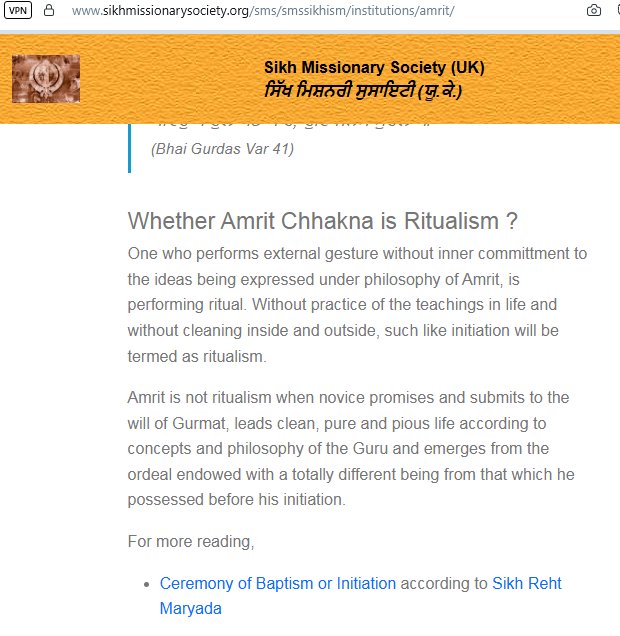
(Above, Sikh websites in denial)
[2] https://www.reddit.com/r/Sikh/comments/v12nqy/is_it_true_that_guru_nanak_let_people_drink_his/
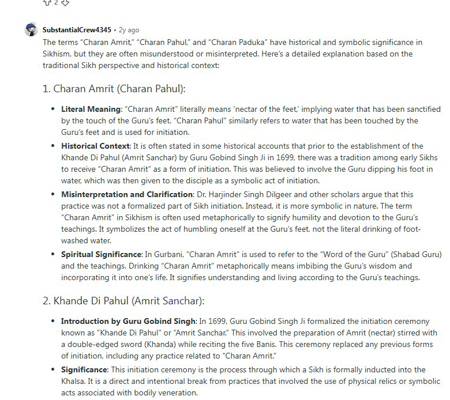
(Above, Sikh cometary's in denial)
BDSM/Femdom & Sikhism

Sikh history and the psychological crossover with physical fetishes highlights several critical truths about how these distortions function. A proud, high-caste Hindu Brahmin or Rajput warrior who wanted to join the Guru's egalitarian movement had to completely annihilate his ego by bowing to the Guru's feet and drinking that water. It was an ultimate lesson in humility. Corrupt masands (tithe-collectors/local leaders appointed to manage Sikh communities) began demanding that local Sikhs wash their feet and drink the water, using the practice to establish their own mini-fiefdoms, feed their egos, and extort money.
- In Secular Contexts (Femdom/Fetish): This is done consciously for psychological or physical gratification. It relies on the deliberate eroticization of power differences, where one party willingly hands over control.
- In Religious Contexts (Exploitation): Corrupt authority figures throughout history have instinctively weaponized this exact same psychological trigger. By framing an act of extreme physical subjugation as a "spiritual requirement," they bypass the victim's critical thinking.
Blind Devotion is a Human Flaw, Not a Religious One
Whenever people surrender their critical thinking to another human being out of fear, a desire for quick salvation, or psychological dependency, a vacuum is created. And history shows that wherever a psychological vacuum of blind devotion exists, a greedy or power-tripping opportunist will inevitably step in to exploit it.
- The Secular Person: Submits physically experiences psychological surrender receives the reward of dopamine, stress relief, or personal sexual gratification.
- The Sikh Devotee: Submits physically experiences psychological ego- receives the reward of divine Guru peace, a sense of belonging, and cosmic salvation.

Had Guru Gobind Singh kept the Charan Pahul system intact while declaring that the Guru and the Khalsa (the disciples) were completely equal, he would have logically had to drink the foot-water of his own disciples to receive initiation from them.
The Paradox of "Aapae Gur Chela" (Himself the Guru and Disciple)
"Waho Waho Gobind Singh Aapae Gur Chela"
(Wonderful, wonderful is Gobind Singh; he is himself the Guru and the Disciple) - 41st Vaar (Chapter 41, Pauri 1)
- The Event: After initiating the first five disciples (Panj Pyare ), Guru Gobind Singh knelt before them, folded his hands, and asked them to initiate him into the Khalsa brotherhood.
- The Logistical Reality: If the initiation still required drinking foot-water, the Guru Gobind would have had to wash the feet of those five men and drink it.
- The Elimination of the Ego Vacuum: By changing the medium to water stirred with steel in an iron bowl, the ritual was completely detached from any single human body. It belonged to the collective community (Sangat ) and the Divine. It became an objective, universal ceremony where no human being's feet were elevated above another's.
Sikh Apologist: A Cosmic Shift: From Devotee to Warrior-Saint

The Single Most Heavily Guarded Narrative in Sikh Apologetics Crushed:
The illusion of A Perfectly Seamless, Divine progression!

The Timeline Conflict: The Warrior and the Foot Nectar
- The 1606 Reality: When the 5th Guru Arjan was executed by the Mughals, his son, Guru Hargobind, became the 6th Guru in 1606. He immediately inverted the passive image of the faith. He wore two swords (Miri and Piri ), built the fortress of the Akal Takht, established a standing army, engaged in multiple fierce battles, and hunted wild animals.
- The Contradiction: During this entire 6th Guru martial era—and through the reigns of the 7th, 8th, and 9th Gurus—the mandatory entrance ritual remained Charan Pahul .
- The Logistical Truth: This means that the fearsome warriors who fought alongside Guru Hargobind in the early 1600s were the exact same people who knelt down, scrubbed human big-toes, and swallowed the dirty run-off wash-water to enter the faith!
Therefore, the defensive claim that foot-drinking inherently trapped the mind in a passive state completely collapses. History proved that you could simultaneously be a lethal, armored warrior and a submissive, foot-drinking Sikh devotee ass-licker.
The Operating System Paradox
- The Theological Claim: The Gurus were perfectly enlightened vessels channeled by an omniscient, timeless Creator (Akaal Purakh ). Their decisions were transcendent, flawless, and universally true from day one.
- The Rationalist Historical Reality: The movement functioned exactly like an evolving, reactive human political state. It required constant, radical restructuring because its previous policies failed to withstand changing sociological conditions.
The Reversion to the Insider vs. Outsider Loop
- If the purpose of a ritual is to break human arrogance and equalize society, it ceases to be a philosophy of non-dual, universal love when you weaponize the absolute baseline of that submission against people outside your specific club.
- By establishing a system where an independent, moral humanist who uses their reason to stay outside the gate is textually degraded as a "blockhead" or a "filthy animal," the religion betrays the very concept of egalitarian brotherhood it claimed to invent.
The Ultimate Realization
Sikhism did not descend from heaven as a pristine, timeless blueprint. It was a fluid, evolving medieval movement that started as poetic, open-ended Indian (plagiarized) mysticism, militarized midway through while retaining heavy Puranic submission rituals, and was ultimately forced into a radical, top-down emergency transformation in 1699 to survive political erasure.