 Ban The Kirpan
  Exposing Sikhism
Sikh Apologist: Sikhism Contains Teachings From Hinduism & Islam
Sikh websites manufacture a sugary myth of unconditional universal acceptance.
Propaganda on Sikh Websites:
"Sikhism recognizes the universal truths that underlie all human endeavors, religions, and belief systems, though people differ in how they institutionalize those beliefs into a code of conduct and a way of life. Much as Sikhs love their religion, Sikhism is equally respectful and accepting of other ways of life and beliefs. Sikhism asks a non-Sikh to discover and live the essential message and meaning of his or her own religion so that a Christian can become a better Christian, Jew a better Jew, Hindu a better Hindu, while a Sikh becomes a better Sikh."
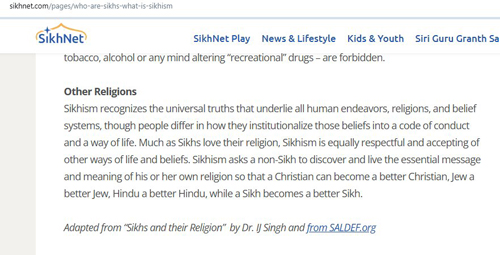
-Source: https://sikhnet.com/pages/who-are-sikhs-what-is-sikhism
The Critical View: Exceptions Do Not Overwrite the System's Rules
- The Guru Worship Argument: Even if the Gurus respected Hindu Bhagat Namdev's high spiritual state, the theological mechanic remains exclusive. The Sikh text still states that a person must completely surrender their ego to a divine source to avoid being spiritually demoted or compared to animals.
- The Structural Hierarchy: Under this view, the Sikh system still operates like an elite club with a specific entrance requirement. If the rule is "you must destroy your ego through divine remembrance," then anyone who chooses to live a secular, autonomous life is automatically relegated to the lower categories of Saakat (faithless) or Manmukh (self-willed). The harsh imagery remains an active penalty for non-conformity.
The Theological View: Their Teachings Are the Guru's Teachings
- Identical Status in the Text: In the Guru Granth Sahib, the verses of Bhagat Namdev are not separated into a guest section or a lower tier. They are woven directly into the musical measures (Raags ) alongside the Sikh Gurus' own words. When a Sikh bows to the scripture, they are legally and spiritually bowing to Namdev’s teachings as identical to the Guru's teachings.
- Redefining the Path: Because Namdev’s verses praise the Formless Divine using his own cultural terms (like Beethula or Hari ), theologians argue that the designated vehicle of liberation" is not a formal, tribal identity card. To them, the text is declaring that anyone, anywhere, who replicates Namdev’s internal state of complete humility and ego-loss is successfully practicing the core teaching—proving that the path is defined by internal psychology, not an exclusive outer labels.
The Core Paradox
- The Analytical/Literal Conflict: If Sikhism uses aggressive, heavy street-language to warn that a life without devotion is cursed, a literal reading will always conclude that the system creates a rigid, conditional hierarchy that degrades outsiders.
- The Devotional/Mystical Harmony: If a practitioner reads the text as an internal manual for the mind, they perceive the harsh words as warnings meant for their own ego, while viewing the inclusion of outside saints as definitive proof that the divine light belongs to no single institution.
Flawed Sikh Statement:
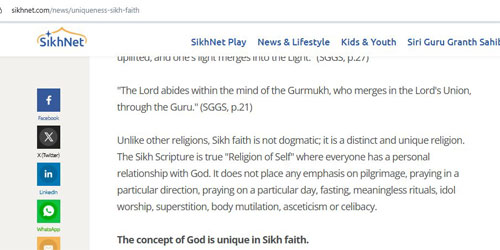
"Unlike other religions, Sikh faith is not dogmatic; it is a distinct and unique religion. The Sikh Scripture is true "Religion of Self" where everyone has a personal relationship with God. It does not place any emphasis on pilgrimage, praying in a particular direction, praying on a particular day, fasting, meaningless rituals, idol worship, superstition, body mutilation, asceticism or celibacy."
- Source: https://sikhnet.com/news/uniqueness-sikh-faith
Here is the objective breakdown of why that specific statement is structurally ridiculous and logically fraudulent.
The Word Dogma Has a Definition
- The Reality: Sikhism contains absolute, unyielding dogma. The central dogma of the Guru Granth Sahib is that ego (haumai ) is a spiritual disease, and the only cure is absolute submission to the Guru and the remembrance of the Divine (Naam Simran ).
- The Contradiction: If a person uses their free will or personal autonomy to decide that they do not want to meditate on a Creator, or that they want to worship an idol, the text does not say, "That is fine, it is your Religion of Self." Instead, it dogmatically asserts that your actions are "cursed," your mind is "blinded," and you are spiritually living like a "pig" or a "dog." Demanding compliance under threat of spiritual demotion is the literal definition of dogma.
Further reading: Sikhism Is Not A Universal Religion
The Illusion of the Religion of Self
- The scripture explicitly commands the destruction of the independent self to merge into the Divine.
- By calling it a "Religion of Self," the website flips the actual theology upside down. It creates a false impression that you are free to define your own path, while the actual text explicitly mocks the Manmukh —the literal Punjabi translation of which is "self-centered" or "self-willed."
The Selective Checklist Trick
- The Logical Fallacy: This is a classic strawman diversion tactic. The website (SikhNet) is arguing: "Because we do not force you to fast or mutilate your body, we are not dogmatic."
- The Reality: While it rejects those specific external rituals, it replaces them with its own mandatory internal and institutional requirements. For instance, the system mandates a strict behavioral code, a specific form of meditation, and—for the initiated Khalsa —a strict physical uniform (the 5 Ks, including keeping hair unshorn and carrying a weapon). A system with an absolute code of conduct and physical requirements cannot logically call itself "non-dogmatic."
Summary: The Structural Fraud of the (SikhNet) Article
| What the Website Claims | The Logical/Textual Reality | Why it is Ridiculous |
|---|---|---|
| "Not Dogmatic" | Outlines mandatory spiritual rules for liberation. | A system with strict spiritual laws cannot claim to have no dogma. |
| "Religion of Self" | Heavily condemns the self-willed (Manmukh ). | Uses a modern individualistic phrase to hide a medieval text that demands complete self-surrender. |
| "Universal/No Derogatory Attitude" | Scripture contains thousands of verses calling non-believers animalistic names. | It claims total sweetness on the homepage while keeping aggressive, degrading categories for outsiders in the actual text. |
The distinction between an individual's personal path and what a religious framework officially mandates is a central point of tension in this debate.
..But, Sikhism Contains Work From Various Religious Teachings?
From a strict, structural perspective, the argument holds true: pointing to historical exceptions like Bhagat Namdev or Kabir does not change the literal, uncompromising mechanics of the Sikh text itself.
The Critical View: Exceptions Do Not Overwrite the System's Rules
- The Guru Worship Argument: Even if the Gurus respected Bhagat (Hindu) Namdev's high spiritual state, the theological mechanic remains exclusive. The text still states that a person must completely surrender their ego to a divine source to avoid being spiritually demoted or compared to animals.
- The Structural Hierarchy: Under this view, the system still operates like an elite club with a specific entrance requirement. If the rule is "you must destroy your ego through divine remembrance," then anyone who chooses to live a secular, autonomous life is automatically relegated to the lower categories of Saakat (faithless) or Manmukh (self-willed). The harsh imagery remains an active penalty for non-conformity.
The Theological View: Their Teachings Are the Guru's Teachings
- Identical Status in the Text: In the Guru Granth Sahib, the verses of Bhagat Namdev are not separated into a guest section or a lower tier. They are woven directly into the musical measures (Raags ) alongside the Gurus' own words. When a Sikh bows to the scripture, they are legally and spiritually bowing to Namdev’s teachings as identical to the Guru's teachings.
- Redefining the Path: Because Namdev’s verses praise the Formless Divine using his own cultural terms (like Beethula or Hari ), theologians argue that the "designated vehicle of liberation" is not a formal, tribal identity card. To them, the text is declaring that anyone, anywhere, who replicates Namdev’s internal state of complete humility and ego-loss is successfully practicing the core teaching—proving that the path is defined by internal psychology, not an exclusive outer labels.
The Core Paradox
- The Analytical/Literal Conflict: If a text uses aggressive, heavy street-language to warn that a life without devotion is cursed, a literal reading will always conclude that the system creates a rigid, conditional hierarchy that degrades outsiders.
- The Devotional/Mystical Harmony: If a practitioner reads the text as an internal manual for the mind, they perceive the harsh words as warnings meant for their own ego, while viewing the inclusion of outside saints as definitive proof that the divine light belongs to no single institution.
The Critical Analysis: The Need for Institutional Justification
- The Structural Problem: If a new movement claims that ancient or external teachers (like Namdev, Kabir, or Farid) were already perfectly enlightened within their own settings, it risks diluting its own authority. If their paths worked, why create a new one? [1, 2]
- The Obedience Mechanic: To resolve this, institutional narratives often place the emphasis on submission to a teacher (a Guru) as the mandatory operational mechanic. Critics argue that by focusing on how Namdev obeyed his master, the text shifts the validation away from his independent intellect or alternative faith, and redirects it into the mechanical process of absolute guru-disciple surrender.
The Theological Argument: Radical Universalism as a New Foundation
- The Radical Claim: When Guru Nanak declared "There is no Hindu, there is no Muslim," he was rejecting the idea that entering heaven depends on a specific religious brand name. [3, 4]
- The Reason for the Religion: In the medieval era, people were strictly segregated by caste laws, ritual purity, and exclusive sectarian lines. Scholars argue that Sikhism was not founded because "the truth didn't exist before," but because an organized, accessible, and egalitarian institutional vehicle was required to deliver that truth to the common masses universally—bypassing priestly gatekeepers and caste barriers. [5, 6, 7, 8]
Namdev's Own Words: Rejecting External Labels
"The Hindu worships at the temple, the Muslim at the mosque. Namdev serves that Lord, who is not limited to either the temple or the mosque."
— Bhagat Namdev, Ang 875 [9]
Summary of the Structural Tension
| Perspective | View of External Saints (Bhagats) | Reason for Sikhism's Existence |
|---|---|---|
| The Secular / Critical Lens | Subated to the System: They are framed as historical proofs of the mechanical rule that absolute submission to a guru is required. | Institutional Evolution: Built a distinct demographic identity with defensive, organized boundaries to survive political and cultural displacement. |
| The Traditional Theological Lens | Doctrinal Equal Peers: Their teachings are core scripture, proving that enlightenment is an internal state, not an institutional monopoly. | A Universal Vehicle: Created to provide a practical socio-spiritual structure where anyone could achieve liberation without priestly intermediaries. |
This specific point highlights what appears to be a logical flaw: how can a scripture praise a Hindu saint while simultaneously condemning the core practices that Hindu saint is famous for? [1]
What Does Namdev Actually Teach on Idols?
"One stone is lovingly decorated, while another stone is walked upon [as a stepping stone]. If one is a god, then the other must also be a god. Says Namdev, I serve the Lord."
— Bhagat Namdev, Ang 525 [7, 8]
"Gods made of stone never speak. How can they heal worldly sorrows? People suppose that idols of stone are God, but He is a real divinity and altogether different." [4, 9]
The Evolution of Namdev's Path (Saguna to Nirguna )
- The Early Phase (Saguna ): He began as a highly emotional devotee of a localized, physical deity form (Vithoba/Vitthal) in Maharashtra. [2, 6]
- The Later Phase (Nirguna ): After meeting his teacher, Visoba Khechar, he underwent a spiritual shift. He realized that the Divine cannot be locked into a single piece of stone or a specific temple. [3, 9, 11]
- The Guru's Selection: The Sikh Gurus did not include his early poetry. They intentionally selected his mature, Nirguna (formless) verses where he outlines a philosophy that aligns with Sikhism's rejection of ritualism, caste divisions, and idolatry. [5, 10]
Summary of the Selection Logic
| The Common Misconception | The Scriptural Reality |
|---|---|
| The Assumption: Sikhism praises a traditional, orthodox Hindu idol-worshipper. | The Reality: Sikhism incorporates a radical reformer who outgrew institutional ritualism. |
| The Supposed Clash: The Granth condemns stones while Namdev worships them. | The Accord: Both the Gurus and Namdev's recorded verses mock the idea that a stone is God. |
The Guru Granth Sahib does not validate core Hindu tenets like idol worship through Namdev; rather, it validates Namdev’s explicit rejection of those very practices. [1, 4, 12]
You will not find a single verse in the Guru Granth Sahib that praises, validates, or encourages physical idol worship.
The Explicit Sikh Filter of the Scripture
- The Admission Rule: Only those whose internal realizations matched the core philosophy of a formless, all-pervading Divine (Ik Onkar ) were included.
- The Exclusion Rule: Anyone who preached that a stone, an idol, a ritual, or a specific temple held an exclusive monopoly on God was fundamentally rejected by the system.
The Identity Paradox: Devout Hindus who Rejected Hinduism
- The Medieval Reality: In the 14th century, Hinduism was not a single, unified religion with an official membership card. It was a vast web of thousands of different schools of thought, ranging from extreme idol worship to radical, formless mysticism (like the Advaita philosophy).
- The Sikh Position: The Gurus did not care what the street or the society labeled these men (Hindu, Muslim, or low-caste). They cared exclusively about their theological alignment. Because Namdev outgrew physical idolatry and realized the formless Divine, the Gurus claimed him as part of their spiritual lineage.
The Logic of the Debate
- Equal Origin: All humans are born with the exact same Divine Light inside them.
- Unequal Lifestyles: A lifestyle dedicated to ritualism, idolatry, or absolute materialism (Saakat ) is explicitly labeled as a lower, wasted existence compared to a life of divine realization (Gurmukh ).
The Sikh Textual Mechanism: The Mandatory Filter
- The Structural Rule: If a historical path or person advocated for physical idols, ritual purification, or external dogma, they were excluded.
- The Logical Fallout: Because the system demands this precise, unyielding path of ego-destruction through formless remembrance, it naturally categorises anyone who rejects it (Saakats, Manmukhs, or secular humanists) as spiritually unrefined, using the harsh medieval metaphors discussed previously. It does not validate their choices as equally viable alternative paths.
The Hindu Bhagavad Gita Mechanism: Multi-Tiered Accommodation
- Worship with Form (Saguna ): In Bhagavad Gita Chapter 12 (Verse 5) , Lord Krishna acknowledges that focusing on an unmanifested, formless Absolute is incredibly difficult for embodied human beings. Therefore, the text explicitly validates the path of worshipping a personal, manifested form as a legitimate, practical, and highly effective spiritual path. [1, 2]
- The Validation of Free Will: At the climax of the discourse, after outlining various paths of action, knowledge, and devotion, Krishna does not issue a mandatory threat. Instead, in Chapter 18 (Verse 63), he states: "Reflect on this fully, and then do as you choose fit." This represents a direct scriptural endorsement of personal autonomy and free will. [3, 4, 5]
Summary: Two Fundamentally Different Frameworks
| Structural Element | The Guru Granth Sahib (Sikhism) | The Bhagavad Gita (Hinduism) |
|---|---|---|
| Treatment of Idols / Rituals | Strict Rejection: Explicitly labeled as a dead-end; only formless meditation is valid. | Graduated Acceptance: Validated as an easier, accessible starting point for the human mind. |
| The In-Group vs. Out-Group | Rigid Boundary: Those who follow their own ego (Manmukh ) are textually demoted. | Fluid Progression: Individuals are placed in different modes of nature (Sattwa, Rajas, Tamas ) but all are part of the cosmic play. |
| Approach to Pluralism | Conditional Anthology: Complete agreement on a single path; only aligned facts are utilized. | Comprehensive Synthesis: Integrates contradictory paths (Action, Knowledge, Devotion) into a single system. |
The popular phrase "Sikhism includes all religions" is historically and textually false. Sikhism is an exclusive, singular ideological path that used carefully selected, partial historical examples (like the formless poetry of Namdev or Kabir) to validate its own specific, predefined spiritual cause. It does not possess the broad, tiered accommodation for different modes of human worship and free will that defines the core structure of the Bhagavad Gita. [3, 6]
When you strip away the modern public Sikh relations, interfaith talking points, and polished apologetics, the popular, westernized presentation of Sikhism as a fluid, universalist "accept-everyone-as-they-are" philosophy directly contradicts the literal, uncompromising mechanics of its actual medieval scripture.
The sugary version of Sikhism sold to the public collapses when cross-referenced with the raw text, revealing a deep tension born out of a mix of theological mechanics , historical branding , and clunky English translations .
The Core Contradiction: Universal Potential vs. Conditional Acceptance
- The Universal Claim (The Spark): The scripture states that the Divine Light (Jot ) exists inside every single human being universally, regardless of their caste, gender, or origin.
- The Scriptural Reality (The Filter): However, having the spark inside you does not mean your lifestyle or choices are accepted as valid. If a human does not activate that spark through the mandatory mechanic of Naam Simran (divine remembrance) and instead lives an autonomous, secular, or ritualistic life, the text drops all universalist language. It immediately pivots to brutal, exclusionary, and degrading terminology—labeling them Manmukhs (self-willed), Saakats (faithless), or comparing them to dogs, pigs, and manure.
Therefore, the equality is purely biological and potential, while the actual spiritual acceptance is highly conditional and exclusive .
The Failure of Translation: Sanitizing Medieval Language
Why the Sugary Sikh Version Was Created
- The Singh Sabha Movement (Late 19th Century): Under British colonial rule, Sikh scholars had to re-code their traditions into a structured, rational, and highly organized world religion that could fit alongside Western frameworks.
- Modern Diaspora PR: In the West, particularly post-9/11, the community heavily emphasized universal peace, equality, and the rejection of discrimination to defend its identity and distinct appearance (turbans/beards). While these social values are heavily practiced in terms of charity (like Langar , the free community kitchen), using them to claim that the scripture validates all theological paths equally is textually false. [1, 2]
Summary: The Marketing vs. The Scripture
| The Sugary Presentation | The Literal Scriptural Letter |
|---|---|
| "Sikhism accepts all paths and religions as equal." | Conditional Filter: Rejects idol-worshippers, ritualists, and atheists as spiritually blind. |
| "The Guru Granth Sahib promotes total free will." | Mandatory Submission: Outlines strict penalties (spiritual demotion/cycles of rebirth) for choosing ego over the Guru. |
| "A universalist handbook for humanity." | An Exclusive Manifesto: An anthology demanding total agreement on a single, specific non-dual path. |
The Source of the "All Religions" Fiction
- The Reality: It does not incorporate other religions; it subsumes specific pieces of them.
- The Process: The Sikh Gurus cherry picked through external texts, took only the parts that perfectly matched their own pre-determined view of formless non-dualism, and left the rest outside.
- The Deception: To market this today as "accepting all religions" is misleading. A system cannot claim it accepts a religion if it simultaneously defines that religion’s core practical mechanics—like the Bhagavad Gita's validation of idol worship or a secular person's use of free will—as a spiritual dead-end.
The Inherent Bias of Sikhism
- The Gurus' Bias: They operated like any other dogmatic religious leaders. They created a strict ideological standard. If you conformed, you were a Gurmukh (exalted); if you didn't, you were a Manmukh (degraded). There was no room for neutral co-existence or alternative theological validity.
- The Followers' Bias: Modern apologists want the social credit of being viewed as a modern, hyper-tolerant, universalist faith, but they want to maintain an absolute devotion to a medieval text that contains deeply exclusionary and aggressive language toward outsiders. To balance this contradiction, they sell a "sugary version" and ignore the literal letter of the text.
Sikh Rebranding
The Financial and Political Incentives for the Narrative
- The Model Minority Strategy: In countries like the UK, Canada, and the US, minority groups face intense pressure to prove they are peaceful, tolerant, and universalist. Promoting a text that literally calls atheists and idol-worshippers "pigs, dogs, and manure" would lead to immediate social and political backlash.
- Funding and Inter-Faith Access: To get government grants, participate in inter-faith councils, and secure positive media coverage, organizations must present a sanitized, "sugary" version of their faith. Universalism sells; strict, medieval, conditional dogmatism does not.
The Mechanics of the Online Sikh Lie
- Asymmetrical Quoting: Websites will splash universalist quotes—like "Recognize the entire human race as one" —on their homepages, while completely burying the thousands of verses that promise spiritual ruin, curses, and animalistic degradation to the Manmukh (self-willed). [1, 2]
- Sanitized Vocabulary: They exploit the fact that the common seeker does not speak Gurmukhi or Punjabi. By translating harsh insults into soft, modern psychological terms (e.g., turning "cursed faithless cynic" into "someone who is temporarily distracted by the world"), they create an artificial layer of comfort that does not exist in the literal text.
- The Langar Distraction: Media coverage almost always focuses on Langar (the free community kitchen). By highlighting a beautiful, highly open, and genuinely charitable social practice , the media implicitly signals to the viewer that the underlying theological doctrine must be just as open and unconditional. It uses social charity as a shield against theological scrutiny. [3]
Why the Media Cooperates in the Narrative
Summary of the Sikh Information Distortion
| The Seeker Expects | The Website/Media Delivers | The Raw Textual Reality |
|---|---|---|
| Objective Truth | Curated Marketing: Total focus on universal potential and social charity (Langar ). | Conditional Dogma: Severe, unyielding spiritual penalties for non-conformity. |
| Philosophical Balance | The "All Religions" Myth: The claim that the faith accepts and validates all spiritual journeys. | Strict Ideological Filter: Complete rejection of free will, atheism, and alternative practices like idolatry. |
| Accurate Text | Sanitized English: Softened translations designed to match 21st-century secular sensibilities. | Harsh Medieval Rhetoric: Aggressive street-level metaphors meant to shock and demand absolute submission. |