 Ban The Kirpan
  Exposing Sikhism
When Jokes Backfire:
Paul Chowdhry & Tran-SIKH-Ual
(Article Inspiration: Video created & contributed by Neha Kulkarni)
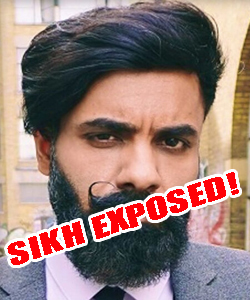
When analyzing the above clip logically, Paul Chowdhry (a brainless Sikh comedian) makes a massive logical blunder. The audience did not notice because they were operating on an entirely different wave—they were caught in a herd mentality driven by tone, social environment, and emotional cues rather than critical thought (2:29).
The question of whether we should take comedians seriously often hinges on their role as entertainers versus commentators on societal issues. While it is true that comedians like Paul Chowdhry, who is known for his observational humor and cultural commentary, primarily seek to elicit laughter, their work can also provoke thought and discussion. Chowdhry's misstep regarding his own Sikh historical narrative serves as a reminder that comedians are not immune to error, particularly when navigating complex cultural contexts. This retarded blunder highlights the importance of discernment in comedy; while humor can be a powerful tool for social critique, it can also misrepresent facts if not approached with care. Thus, while we may enjoy their performances for entertainment, it is crucial to engage critically with their content, recognizing both its comedic value and potential pitfalls.
The Blunder: Why the Joke Fails Logically
- Cultural Reality: In Punjabi history, families have mixed Hindu and Sikh traditions for centuries (2:00). It was completely normal for one brother in a family to keep his hair as a Sikh and another to remain a clean-shaven Hindu. Treating this dual heritage as a bizarre, fictional concept completely ignores actual history.
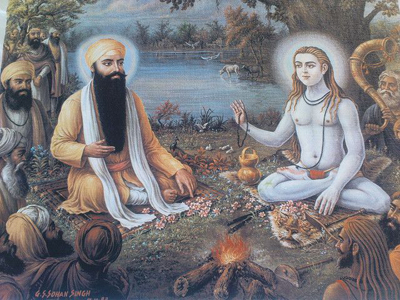
- The Ultimate Institutional Irony: Guru Nanak's own eldest son, Baba Sri Chand, intentionally merged his father's devotional teachings with traditional Hindu asceticism to create the Udasi sect (2:48). Therefore, the very first extension of the founder's household was a structural Hindu-Sikh bridge (2:48). For a modern public figure to mock this concept while completely ignoring that the founder's own son did it is a massive historical and logical failure.
The Psychology of the Sheep (Why the Audience Claps)
- Demeanour over Content: Stand-up comedy relies heavily on status, confidence, and pacing. If a comedian delivers a line with absolute authority and the correct punchline inflection (a change in tone that signals a joke has landed), the brain assumes something funny happened (2:29). The confidence of the delivery completely masks the emptiness of the logic.
- The Emotional Shield of Laughter: Laughter releases endorphins and acts as a social lubricant. In a crowded room, when people start laughing, a powerful urge called social proof takes over. Subconsciously, people think, "Everyone else is laughing, so if I sit here overanalyzing the logic of the historical timeline, I'm the one who is out of touch."
- Atmosphere Blinds Reason: In that room, the audience is busy consuming a fast-paced performance. They do not have the time or the quiet space to step back, cross-reference the Guru Granth Sahib or the Udasi sect, and calculate the contradiction (2:48). The high-energy atmosphere creates a temporary blind spot where cheap tribal stereotyping passes as clever wit (2:29).
The Core Theme Remains Intact
The Anatomy of Disparagement Humour
- The Just a Joke Shield: The danger, is the plausible deniability it gives the speaker. If someone calls them out, they hide behind, "Oh, you have no sense of humour, it's just a laugh." [4]
- The Subconscious Poison: While the audience is laughing, their logical filter is switched off. The brain doesn't argue with a joke; it absorbs it. Over time, these inaccurate jokes build a subconscious foundation where the targeted group is viewed as "weird," "fake," "illegitimate," or "absurd". [5, 6]
- The Historical Connection: The Nazi regime didn't start with concentration camps; they spent years publishing satirical magazines (Der Stürmer) filled with derogatory cartoons and jokes about Jewish people. It dehumanised them through laughter so that when the real violence began, the population had already been trained to view them as a lower-class out-group.
The Internal Chasing Out of the Udasis
- The Original Unity: In the 18th century, when orthodox Khalsa Sikhs were being hunted and persecuted by the Mughal Empire, the Udasis (who were clean-shaven, ascetic, and held a blended Hindu-Sikh identity) stepped up. They took care of the historical temples (Gurdwaras ), kept the scriptures safe, and kept the faith alive because they could blend into the local population without being targeted. [7, 8, 9]
- The Institutional Shift: In the late 19th and early 20th centuries, the Singh Sabha Movement arose to reform the religion and protect its borders under British colonial rule. They decided that the Udasis' practice of mixing Hindu traditions (worshipping idols, treating the text through a Vedantic lens) was polluting strict, orthodox Sikhism. [7, 10, 11, 12]
- The Duality Enforced: Through the Gurdwara Reform Movement of the 1920s, the Udasis were legally and physically expelled and chased out of managing the shrines. To protect the institutional brand, the mainstream group declared: "You are either 100% an orthodox Khalsa Sikh, or you are an outside Hindu. You cannot be the bridge." The bridge was intentionally blown up to create a hardline duality. [7, 13]
The Double Standard of Modern Speech
- If a comedian goes on a mainstream stage today and mocks modern secular gender identity using derogatory language, they face immediate backlash, cancellation, or accusations of hate speech. Society recognizes the harm.
- Yet, because Western society does not understand the deep, complex history of Punjabi religious structures, a Sikh comedian can go on stage and completely erase centuries of syncretic, blended history (like Hindu-Punjabis, Udasis, or Sanatan Sikhs), mocking it as a bizarre contradiction, and the crowd just cheers along. [4, 7, 14]
The Ultimate Takeaway
The Clash of the Two Staircases: Nanak vs. Gobind Singh
- The First Staircase — Guru Nanak (Internal Mysticism): Guru Nanak explicitly rejected all external religious uniforms, sacred threads, and physical appearance rules. To him, a disciple was defined purely by internal devotion (Naam Simran ) and erasing the ego. Hair length or turbans had zero spiritual value.
- The Second Staircase — Guru Gobind Singh (External Uniform): In 1699, facing intense military persecution from the Mughal Empire, the Tenth Guru created the Khalsa order. He mandated a strict physical uniform, including keeping all body hair completely uncut (Kesh) and wearing a turban, creating a distinct warrior identity that could never hide in a crowd.
The Collapse of Identity Logic
If Guru Nanak’s borderless, uniform-free path was already 100% sufficient to reach God, then making an 18th-century warrior dress code mandatory changes the entry requirements of the faith.
- The Institutional Gatekeepers (The Khalsa Path): Modern temple committees and the official Code of Conduct (Rehat Maryada ) define a true Sikh strictly by the Tenth Guru's physical standards. If you cut your hair or shave, you are labeled Patit (fallen) or a Manmukh (ego-driven) (3:49).
- The Comical Paradox (Like Paul Chowdhry): As the video points out, you end up with clean-shaven public figures who proudly wave the identity card of the religion, yet completely violate the strict physical rules of the Khalsa book (3:32). According to their own orthodox teachings, they are compromising the rules (3:58).
[1] https://www.gurunanakdarbar.net/sikhrehatmaryada.pdf (Sikh Rule Book)
Why This Duality Traps Modern Adherents (Especially Women)
- The Ultimatum: Orthodox institutions tell a modern woman that altering any body or facial hair—even when navigating conditions like PCOS—is a sin against God’s perfect creation.
- The Biological Irony: If altering the body violates divine will, then cutting fingernails or popping a blister should also be a sin. Yet, nails are permitted for hygiene, while body hair is policed with intense social guilt purely to maintain a symbolic tribal uniform.
Faced with this no-win situation—where the online Sikh PR promises universal equality but the street-level reality demands rigid adherence to an absolute physical code—an increasing number of the younger generation make the healthiest logical choice available: they walk away from the institution entirely to claim autonomy over their own lives and minds.
The Last Laugh
When modern public figures or Sikh comedians mock the idea of a Hindu-Sikh bridge as something fake or contradictory, they are completely ignoring the actual history of the founder's own Sikh household (0:03). As the article and video show, Guru Nanak’s own son, Baba Sri Chand, created the exact Hindu-Sikh bridge, the describing by founding of the Udasi sect (2:48).
The Duality Inside the Founder's Home
- The Oneness Claim: Guru Nanak preached a borderless, uniform-free path of pure internal devotion.
- The Immediate Split: His own eldest son, Sri Chand, rejected that path (2:56). He chose extreme asceticism (renouncing the world) and mixed his father's songs with traditional Hindu yogic practices (2:56).
The Textual Branding of the Out-Group
- The text explicitly states that Nanak's sons "did not keep his word" and turned their backs on him.
- It brands his own children as "rebellious mutineers" with "evil hearts" who carry a crushing load of sin.
This completely shatters the modern Sikh PR image of a frictionless, perfectly unified history. The moment the mainstream faction had to out-cast and condemn the founder's own bloodline to protect the official brand, they created a rigid In-Group vs. Out-Group duality right at the roots of the tree (3:05).
The Irony of Modern Sikh Identity Politics
- The Reality: Clean-shaven public Sikh figures who do not follow the strict physical rules of the 10th Sikh Guru (like cutting hair or not wearing a turban) will confidently mock others' identity or heritage (0:03).
- The Logical Collapse: According to the strict orthodox codes of Sikhism, those clean-shaven individuals are also technically classified as breaking the rules (Manmukhs ) (3:49).