 Ban The Kirpan
  Exposing Sikhism
Low IQ Sikh Guru Ram Das
Did Sikh Guru Ram Das Misunderstand Elephant Behavior?
Guru Ram Das, 4th
Sikh Guru, shared a lesson about elephants to help his followers understand a deeper message.
He pointed out that when elephants wash themselves, they often become dirty again by rolling in dust. He compared this to people who try to be good but get lost in their ego, forgetting about
God. His aim was to show that just like the elephant’s efforts can be wasted, so can our attempts to be better if we ignore our spiritual journey.
Unfortunately, Guru Ram Das lacked basic knowledge regarding elephants, a fact that was quite surprising given his claims of possessing divine intelligence. While
Guru Ram Das spoke confidently about profound concepts, Guru Ram Das
understanding of nature, particularly the simple truths about these magnificent creatures, was alarmingly shallow. Elephants are known for their intelligence, strong social structures, and emotional depth, yet he failed to grasp these fundamentals. Such a disconnect highlights the importance of grounding one’s wisdom in the reality of the natural world, rather than mere self-proclaimed superiority.

Direct from Sikh sources. Guru Ram Das said:
Page
1314, Line 9
Without the Name, no matter what people may do, they continue to waste away in egotism.
Guru
Ram Das
Page
1314, Line 10
Elephants
can be washed and bathed
in water, but they only throw dust on their heads again.
Guru
Ram Das
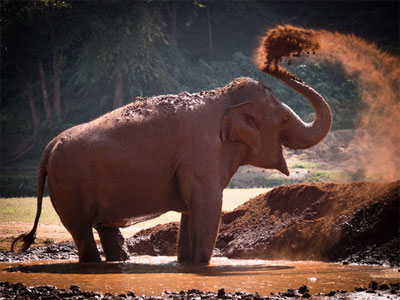
Why Clean Elephants Spray Dirt
- They cannot sweat: Elephants have virtually no sweat glands. To prevent overheating in brutal tropical climates, they rely heavily on external cooling mechanisms.
- The Cooling Pack effect: Wet mud or moist dust traps water against their skin. As the wind blows, this moisture evaporates slowly, drawing heat away from their bodies far longer than a standard water bath would.
- Natural Sunscreen: Despite being thick, an elephant’s skin is highly sensitive and prone to painful sunburns. Coating themselves in dirt provides a physical shield against intense UV rays.
- The Healing and Exfoliation Process: When dirt or mud dries, it cracks and cakes off. As it falls away, it drags away dead skin cells, ticks, biting flies, and other external parasites that cause infection.
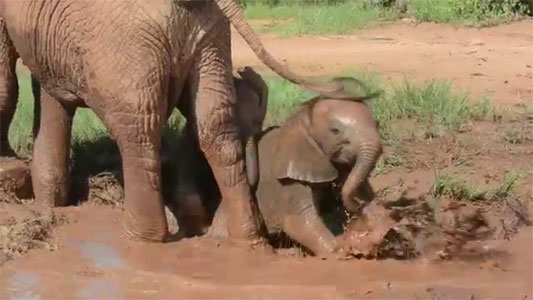
The Scientific Evidence
- The Temperature Regulation Study: A landmark study published in the journal Journal of Thermal Biology titled "Asian elephants (Elephas maximus ) dust bathe in response to an increase in environmental temperature" proved that dusting is a direct physiological response to heat. Researchers tracked elephants and confirmed that as ambient temperatures rose, the frequency of dust-bathing significantly increased to keep their internal core temperature safe.
- Skin Wrinkle and Moisture Retention Studies: Research highlighted by the American Association for the Advancement of Science (AAAS) and evolutionary biologists shows that elephant skin is deeply wrinkled. These micro-valleys in their skin are specifically designed to trap mud and dust. The study found that a mud-and-dust-coated wrinkled skin retains up to 10 times more moisture than flat skin, acting as a continuous, wearable cooling system.
- Parasite Control Literature: Historical and modern veterinary studies (such as those by Spearman, 1970) validate the self-healing and skincare aspect. The rough sand and gravel grains act as an abrasive exfoliant, actively assisting the elephant in shedding hard keratinised skin flakes, preventing bacterial buildup.
To cite this article: R. I. C. Spearman (1970) The Epidermis and its Keratinisation
in the African Elephant (Loxodonta Africana), Zoologica Africana, 5:2, 327-338, DOI:
10.1080/00445096.1970.11447400
Source: https://www.tandfonline.com/doi/pdf/10.1080/00445096.1970.11447400
Mud Baths and Dust Baths
"Lots of animals use mud and dust as a natural way to clean and protect their skin. Think about elephants rolling in the mud – it’s not just for fun. That mud acts like a sunscreen, shielding them from the sun’s rays. It also helps get rid of pesky parasites and soothes itchy skin. Birds do something similar with dust baths. They shake dust through their feathers and onto their skin, which helps remove dead skin cells and any tiny bugs that might be hanging out."
Source: https://seaflawlessskin.com/surprising-skincare-secrets-we-can-learn-from-wild-animals
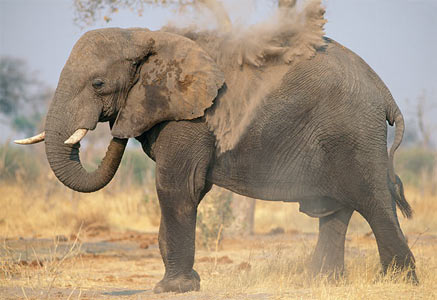
How It Works for Elephants
- It acts as armor: The primary benefit is prevention. A thick layer of dried mud and dust creates a physical barrier that stops new ticks, lice, and biting flies from reaching their skin in the first place.
- It exfoliates: When elephants rub against trees or rocks, the friction pulls off the hardened mud crust. This action successfully drags away dead skin, dried blood, and loose or unattached insects.
The Limitation
- It does not pull out attached ticks: Ticks that have already cemented their mouthparts deep into the elephant's tough skin will not simply fall off with the mud.
- They need helpers: To get rid of these deeply embedded parasites, elephants rely on symbiotic relationships with birds, like oxpeckers and egrets, which pick the stubborn ticks directly out of their skin folds.
The Problem of Forcing the World into a Sikh Box
Why the Bhagavad Gita Avoids This Trap
"Even wise people act according to their own nature. All living beings follow their natural tendencies; what can restraint or suppression accomplish?"
Krishna acknowledges that you have a physical nature, human instincts, and a mind that will naturally react to the world. The goal of the Gita is not to wash you clean like a robot and demand you never touch the dirt of human life again. The goal is to teach you how to remain completely stable and unaffected while you are interacting with the world.
Many Sikh figures spent their entire lives insulated to their surroundings. They memorized massive amounts of scripture and theology, but they lacked a basic, practical understanding of nature, psychology, or science. Because their followers treat every word they say as infallible, nobody ever dares to raise their hand and say, "Actually, that's not why elephants do that." Without checking their ignorance, whatever they wrote gets preserved as divine wisdom for centuries.
Sikh Apologist will say:
"You're comparing a 16th-century spiritual metaphor as if it were a modern scientific textbook."
- Metaphor vs. Science: Spiritual, poetic, and philosophical texts worldwide use observable nature to illustrate human psychology.
- Observational Truth: Historically, an observer sees a freshly washed elephant immediately throw dirt on itself.
- Symbolic Parallel: Guru Ram Das used this striking visual to mirror human behavior—cleansing one's mind only to immediately return to ego or negative habits.
- Intent Misalignment: Critiquing the biological motivation of the animal ignores the literary purpose of the allegory.
- Valid Zoology: Mud and dust protect their skin and regulate temperature.
- Irrelevant to the Lesson: The biological benefits of dust-bathing do not change the visual outcome: the clean animal looks dirty again.
- Universal Practice: Literature frequently uses animal traits metaphorically (e.g., "stubborn as a mule" or "sly as a fox") without requiring a biological justification of the animal's intent.
The elephant is doing something necessary and intelligent for its own survival, but the metaphor is focused strictly on the futility of the sequence from a human point of view.
The Sikh Spiritual Application
- The Ritual (The Water Bath): A person goes to a holy river, temple, or church, undergoes a physical cleansing ritual, and feels spiritually "clean."
- The Ego (The Dust): The moment they walk away, they let pride, anger, or greed take back over, effectively "muddying" their mind all over again.
Debunking Sikh Logic (again!)
Instinct vs. Intentional Behavior
- The Elephant: Follows biological necessity to survive.
- The Human: Follows flawed habits to feed the ego.
- The Conflict: Exposes that the underlying motivations are completely opposite.
- The Sequence: Cleaned - Immediately Dirtied.
- The Core Lesson: The text isolates just this specific loop to illustrate a human who prays or meditates to clear their mind, only to immediately ruin that peace by acting out of arrogance or greed.
Other Everyday Metaphors with the Same Flaw
- "Like a moth to a flame" : Used to describe someone drawn to self-destruction. In reality, the moth is just confused by navigation instincts.
- "Don't hide your head in the sand like an ostrich" : Used to describe someone ignoring problems. In reality, ostriches don't do this; they are actually tending to their eggs or camouflaging.
- "Crocodile tears" : Used to describe fake grief. In reality, crocodiles secrete tears naturally to wipe their eyes while eating.
This is how language, cultural knowledge, and scientific reality clash over centuries—if we judge ancient metaphors by modern zoological facts, they are completely inaccurate.
The Real Inaccuracy of Ancient Proverbs
- The Biological Reality: Many dogs have naturally straight tails, or only curl them based on mood and breed genetics. The curl is not a "defect" or a moral failure; it is just standard canine anatomy.
- The Cultural Trap: This phrase was not invented in the 16th century. It is a millennia-old proverb found in ancient Sanskrit, Arabic, and Greek texts used to describe stubborn habits.
The metaphors are objectively flawed because they assume an animal is doing something wrong when it is just acting naturally.
- The elephant is being smart by applying a physical cooling remedy.
- The dog is just built with a curved tail.
- The moth is simply blinded by its navigation instincts navigation instincts.
When a spiritual writer uses these expressions, they are not teaching biology; they are borrowing the everyday, unscientific slang of their historical era to make a point about humans.
- The Logic: They argue that while the elephant observation is outdated, the human behavior being described is still highly relevant today.
- The Reality: People in 2026 still struggle with hypocrisy, entering a spiritual or meditative state of mind only to immediately return to toxic habits or ego. To them, the flawed elephant idiom is just an old tool used to highlight a very real, modern human problem.
The Literal View vs. The Symbolic View:
- Literalism Fails: If a follower insists that every word in a 16th-century text is literally, scientifically, and biologically accurate in 2026, their logic fails under modern scrutiny.
- Symbolism Preserves: If a follower views the text as a historical document that used the local, imperfect language of its time to communicate timeless psychological and ethical truths, the text remains useful to them as a guide.
Cuckoo Bird Example Vs Elephant Dusting
- The Fact: The cuckoo literally abandons its egg and forces another bird to do the hard work of parenting.
- The Human Behavior: A selfish person dumps their responsibilities onto others for personal gain.
- The Result: The biology and the moral lesson match. The logic works because the animal's actual motivation mimics the human flaw.
By contrast, the elephant metaphor breaks down precisely because the underlying fact contradicts the lesson. The elephant is practicing smart self-care, not foolish self-destruction.
In the study of logic, this specific issue is known as a false analogy. It happens when an argument relies on a surface-level similarity between two things (in this case, the visual of a clean thing getting dirty) while completely ignoring a fundamental difference in reality (the elephant's survival instinct versus human psychological flaws).
The Literal Rejection
The Abstract Separation
- Example 1: A valid metaphor requires the underlying reality of the comparison to match the lesson (like your cuckoo bird example).
- Example 2: The elephant's dust-bath is a smart, natural survival mechanism, not a foolish or self-destructive mistake.
- Example 3: The 16th-century text uses the elephant's bath as a symbol for foolish, self-destructive human ego.
- Conclusion: Therefore, the metaphor relies on a false premise, making the comparison factually and structurally broken by today's standards.
1. Like a moth to a flame
- The Metaphor: Used to describe someone who is foolishly, knowingly, and irresistibly drawn to their own self-destruction.
- The Reality: Moths do not have a death wish, nor are they attracted to light because they like it. They use distant, natural light sources (like the moon) to navigate at a constant angle. A nearby artificial flame confuses their internal compass, forcing them into a spiral that accidentally leads to their death.
- The Logical Failure: The metaphor compares willful human self-destruction to an animal's accidental navigation error .
2. Don't hide your head in the sand like an ostrich
- The Metaphor: Used to scold a person who foolishly ignores a clear danger by pretending it does not exist.
- The Reality: Ostriches never bury their heads in the sand to hide from predators. If they did, they would suffocate. When they sense danger, they lay their heads and necks flat against the ground to blend in with the landscape. From a distance, it just looks like their head is buried. They also use their beaks to turn over their eggs in underground nests.
- The Logical Failure: The phrase uses a smart, highly effective camouflage and parenting tactic to represent human cowardice and ignorance .
3. Sweating like a pig
- The Metaphor: Used to describe someone who is sweating profusely due to heavy exertion or heat.
- The Reality: Pigs have very few sweat glands and barely sweat at all. Because they cannot sweat effectively to cool down, they have to wallow in cool mud to regulate their body temperature.
- The Logical Failure: The phrase attributes a biological trait (heavy sweating) to an animal that literally cannot perform that action .
4. Blind as a bat
- The Metaphor: Used to describe someone with terrible eyesight or a total inability to see what is right in front of them.
- The Reality: Bats are not blind at all. In fact, many species of bats have excellent vision that is perfectly suited for low-light conditions. While they use echolocation to hunt in pitch darkness, their actual eyes work perfectly fine.
- The Logical Failure: The metaphor uses a highly sophisticated, additional sensory skill to imply a physical defect .
This illustrates, Sikh Guru Ram Das was a logical failure. if someone claims to have ultimate, divine authority over the universe, they should at least understand the basic physics and biology of the world right in front of them.
If Guru Ram Das gets a basic, observable fact about an elephant wrong, it damages their credibility. You start to think: "If I can't trust your knowledge on something simple that I can see with my own eyes, why should I trust your hidden spiritual secrets about the universe that I cannot see?"